Greetings and welcome or welcome back! Today's blog is some good news out of New Jersey. Yesterday, representatives from the Shark Research Institute, Humane Society, American Littoral Society, and Jenkinson's Aquarium testified in favor of a bill that would ban the possession, trade, and sale of certain shark fins in New Jersey. I am proud to say that I was one of those testifying in favor! The bill has already passed the state senate and as of yesterday has now passed the assembly appropriations committee by a vote of 8-1.
From here the bill will travel to the state assembly for a vote and if it passes there, it will head to the Governor's desk. I will be sure to post update blogs as things progress with this bill for better or for worse. So what is this bill? The bill is pretty self explanatory. The bill, if signed into a law would bad the sale, possession, and trade of shark fins in New Jersey. While it may sound self explanatory there is some things within the bill that ease some of the opposition's feelings.
First, this bill does not ban the sale of shark fin soup in the state of New Jersey. What it does ban is restaurants illegally obtaining shark fins from other countries, states, etc.. If a restaurant is obtaining fins in a legal manner, then there will be no issue. Keep in mind though the massive problems that shark fin soup is linked to for both humans and sharks alike.
This bill does not hurt recreational fisherman who are good honest fishermen. It will hurt those that catch a shark for the fins and just dispose of the shark's body though. If a fisherman wants to sell the shark's fins, they can. However the whole body of the shark must go with the fins attached. I guess another inconvenience would be that charter boats will no longer be able to nail shark fins to the dock as trophies.... Apparently that's a big deal somehow... Not going to try to explain why that is significant in the long run. In addition, the bill does allow for shark fins to be possessed consistent with licensing for fishing.
Finally, believe it or not, shark fishing is a very tiny market in New Jersey. In fact, 2016 shark fisheries accounted for a whopping 0.51% of all the species landed in the state. Yes, not even 1%. The impact overall of this bill will be minimal and will help to close the loophole in the national shark finning laws. So far 13 other states have passed similar legislation with the most recent being Texas. Even states that are completely landlocked (Nevada) have gotten in on the bans. More locally Delaware, Maryland, Massachusetts, and New York all already have similar legislation in place.
Fingers are crossed and all eyes on the next state assembly meeting where this bill will go up for a vote. If you are a resident of New Jersey, I, along with over 25 organizations whom have signed on in support of this bill ask you to call your legislators and tell them that you support bill A4845! As always thank you for reading and stay tuned as more news about this comes out!
Tuesday, March 19, 2019
Monday, March 18, 2019
Species Focus: Southern Fiddler Ray
Hello everyone, today I will be starting a new blog type that I am going to call Species Focus. These blogs will be educational blogs designed to give some fast, basic facts about different species of sharks, rays, dolphins, and whales. Though the majority of these blogs will focus on sharks and rays, I do plan on sprinkling in dolphins and whales from time to time. The first species I'll be focusing on is the Southern Fiddler Ray.

Southern Fiddler Ray Trygonorrhina fasciata

The Southern Fiddler Ray is a guitarfish that prefers to spend it's time on the sandy, shallow bottom of the sea. It is also known as the banjo shark and the fiddler ray. This species of ray can be found exclusively along the southern coast of Australia. As mentioned previously, they prefer shallow waters, but can be found in waters as deep as over 500 feet.
Like many other species of ray, the choice of food for this species consists largely of shellfish and crustaceans. The Southern Fiddler Ray can grow to be around 4 feet in length and weigh around 15 pounds when full grown. This ray gives live birth to 4 to 6 pups per breeding season. The gestation period of this species is one year (12 months). Interestingly enough the baby rays rapidly develop over the final few months of gestation.
These rays pose no threat to humans and they are of little commercial interest. That being said, the meat of these rays apparently taste pretty good so there is a small demand for it. The fiddler ray is a popular ray in aquariums around the world. They adapt to life in captivity very well. They are known to quickly pick up on target feeding and will still bury themselves in the sand of their exhibits as they would do in the wild.
When it comes to conservation, the Southern Fiddler Ray is currently listed as a species of "least concern". This means that the populations do not reach the criteria for being threatened, vulnerable, or endangered. While there are no protections for this species of ray, it does make it's home in some marine sanctuaries and protected zones. The fiddler ray is abundant throughout its range.
Thank you for reading the first of my Species Focus blogs!

Wednesday, December 26, 2018
Japan to Resume Commercial Whaling. Whales of Antarctica Spared!
Well it didn't take too long for something major to happen to bring me back to whales huh? Over the course of the last couple weeks, news stories have been flying around that Japan was looking to leave the International Whaling Commission and resume the practice of commercial whaling. Japan had threatened to leave the IWC multiple times in the past, but never did. As of this morning however, Japan has officially left the IWC. What does this all mean and why did it finally happen though?
The why is much easier that the what does it mean. The straw that broke the camels back sort to speak could easily be found as recently as this past September. Japan had brought forward a proposal to reinstate commercial whaling. The IWC rejected the proposal and came to the conclusion that whaling was no longer a valid economic activity.It also effectively slammed the door on Japan's long standing loophole by stating that whaling was no longer needed for scientific research. Japan has been hunting whales since 1987 under the guise of scientific research. It was just a few short years ago that the research they were doing was nothing more than commercial whaling. With September's resolutions the loophole was finally tied shut and Japan, left with nowhere to go has now left the IWC. Japan continues to claim that it needs to whale for protein and various other things the whales are used for. So with the why out of the way, the question that we will have to wait and see to be fully answered is what does this all mean.
The easy answer is that this means Japan will begin commercial whaling within it's economic zones and territories in 2019. This also means that the Southern Ocean Whale Sanctuary where Japan has been whaling under the guise of research is finally, finally safe from the Japanese whaling fleet. Japan will not be going to the Southern Ocean Whale Sanctuary anymore as it would be illegal to kill whales there for commercial purposes (yes it was always commercial, but that's politics for ya). Those are the two sure things that we know. We also know that Japan already was hunting whales for "research" in their waters every year as well. What we don't know is how all in Japan may or may not go with this. Will they increase their quotas to make up for the numbers they won't be getting in the Southern Ocean? Will the popularity of whaling and eating whale within Japan continue to decline? Will the whale populations in the North Pacific be sustainable with Japan becoming more focused in the area? With Japan leaving the IWC, will small countries whose votes were previously bought out by Japan change their tune on whale conservation? Will Japan return to the IWC at some point? These are all harder to answer questions that only time will tell us.
The biggest takeaway here is that the Southern Ocean Whale Sanctuary is now an actual whale sanctuary and not just named one. Whales are now free to swim there with no fear of industry slaughtering hundreds of them. The Whale Wars that raged between conservation groups like Sea Shepherd and Greenpeace has finally come to an end in the Southern Ocean. While there had been no physical confrontations over the past couple years due to the Japanese whaling fleet getting some serious tech upgrades and military involvement, the pressure had continued to be poured on and the setbacks for the fleet never really ended. Today we should all celebrate this small victory for the whales in the Southern Ocean. It is not often that we have something like this to celebrate so as we head to 2019, let's raise a glass to the IWC for rejecting Japan's proposal and effectively ending whaling in the Southern Ocean!
The why is much easier that the what does it mean. The straw that broke the camels back sort to speak could easily be found as recently as this past September. Japan had brought forward a proposal to reinstate commercial whaling. The IWC rejected the proposal and came to the conclusion that whaling was no longer a valid economic activity.It also effectively slammed the door on Japan's long standing loophole by stating that whaling was no longer needed for scientific research. Japan has been hunting whales since 1987 under the guise of scientific research. It was just a few short years ago that the research they were doing was nothing more than commercial whaling. With September's resolutions the loophole was finally tied shut and Japan, left with nowhere to go has now left the IWC. Japan continues to claim that it needs to whale for protein and various other things the whales are used for. So with the why out of the way, the question that we will have to wait and see to be fully answered is what does this all mean.
The easy answer is that this means Japan will begin commercial whaling within it's economic zones and territories in 2019. This also means that the Southern Ocean Whale Sanctuary where Japan has been whaling under the guise of research is finally, finally safe from the Japanese whaling fleet. Japan will not be going to the Southern Ocean Whale Sanctuary anymore as it would be illegal to kill whales there for commercial purposes (yes it was always commercial, but that's politics for ya). Those are the two sure things that we know. We also know that Japan already was hunting whales for "research" in their waters every year as well. What we don't know is how all in Japan may or may not go with this. Will they increase their quotas to make up for the numbers they won't be getting in the Southern Ocean? Will the popularity of whaling and eating whale within Japan continue to decline? Will the whale populations in the North Pacific be sustainable with Japan becoming more focused in the area? With Japan leaving the IWC, will small countries whose votes were previously bought out by Japan change their tune on whale conservation? Will Japan return to the IWC at some point? These are all harder to answer questions that only time will tell us.
The biggest takeaway here is that the Southern Ocean Whale Sanctuary is now an actual whale sanctuary and not just named one. Whales are now free to swim there with no fear of industry slaughtering hundreds of them. The Whale Wars that raged between conservation groups like Sea Shepherd and Greenpeace has finally come to an end in the Southern Ocean. While there had been no physical confrontations over the past couple years due to the Japanese whaling fleet getting some serious tech upgrades and military involvement, the pressure had continued to be poured on and the setbacks for the fleet never really ended. Today we should all celebrate this small victory for the whales in the Southern Ocean. It is not often that we have something like this to celebrate so as we head to 2019, let's raise a glass to the IWC for rejecting Japan's proposal and effectively ending whaling in the Southern Ocean!
Monday, December 3, 2018
Captivity or a Chance for Survival Revisited
Welcome or welcome back everyone. To re-kick things off here I am going to actually take a look back at my very first blog that I posted back in 2012. It's a question that has become a massive debate since then and one that I had largely kept away from outside of some thoughts on Blackfish. It's been six years since I posted that blog and thoughts and feelings change, so before getting into all the stuff I'd like to get into here, I'd like to take a few minutes and share some thoughts.
Aquariums
Aquariums, when done right can really be an incredible tool in raising awareness and helping conservation efforts of marine life. Yes, there are aquariums with dirty secrets, play dirty, and are a direct link to several species being exploited. That said, it is not all of them. The majority of Aquariums that you will find (in the United States anyway) have the primary goal of educating the public about the animals that they house. Honestly many of these are not animals that people will just sit at home and look up for themselves. These aren't elephants and lions that have been in the media for years and years. These are smaller animals like horseshoe crabs, sea stars, and menhaden that many people don't even know exist. They don't know they exist and they certainly don't know any issues they may be facing. Sure a lot of people have seen Jaws, but most have never even seen a real shark and are petrified of them from a movie. That's where the aquarium comes in as a massive tool for learning. Overall, the good that aquariums are doing largely outweigh the bad. Again, there are certain facilities that value entertainment and show over education. It's up to you to decide for yourself which is a good versus a bad one though. My feelings and my experience tells me that the majority of these facilities are by no means as awful as the media has stated in the years since Blackfish.
Dolphins
Dolphins and captivity has been a debate that has raged on for a while now. It is one that I have so many mixed feelings about, but I feel like I can summarize it as this. Years ago, before Flipper or Free Willy came out, people were nowhere near as into dolphins as they are today. Back then dolphins were in a similar spot as so many other marine animals. Very little was known (we've only really started to understand them now) and people just didn't care that much. Since then the popularity of dolphins and our knowledge of what they are capable of has exploded. Dolphins, much like pandas, lions, and other notable mammals have the attention of the world. Is there a need for them in captivity though? I have mixed emotions on it. The thing is, it sounds like these animals are very much aware of their situation in captivity. They are incredibly social and wickedly smart. Should an animal like that be contained? I lean towards no honestly. I see the educational benefits. They are there and they are extremely valid. My feeling though is that these animals are popular enough that they do not need to be in captivity for people to take an interest in them. I sit on the beach here and anytime a pod of dolphins comes by it captivates the beach. Not for the silly behaviors and tricks that they can do, but for what they are. With all of that being said I do believe there is a special place in aquariums for dolphins that are no longer fit for the wild and require extra help to survive. Those that have been hit by boats, abandoned, sickly, and otherwise injured are prime examples of this situation.
Whales
This is an easy one for me. I don't think whales have a real place in captivity. Many of the same reasons I feel this way can are the same as the dolphin category. Again, I understand the educational aspect of it, but again we are dealing with animals of great intelligence that know full well of the situation that they are in. At this point there really are only a few species of whale that are in captivity to begin with, but I do believe that enough people care about these animals that we don't need to be taking more of them out of the wild at this point. That could always change, but that's my feelings on it at the moment.
Rays
Rays come in all shapes and sizes. When people hear the term "ray" the first thing that normally comes to mind is a sting ray. The disc shaped bottom dwelling sting ray. I feel like that's a problem. There are all kinds of rays out there. Some massive like the manta ray, others not. Whatever the case, people do not know anywhere near enough about these animals. Many people would be hard pressed to even recognize that different species of rays exist as opposed to just "sting rays". Walk into an aquarium and chances are you will see many species of ray, sometimes within the same tank. Each one vastly different from the other, but you would never have known it. We know so little about these animals and their presence in aquariums is nothing but a good thing for many of the species in existence. Side note: Keeping large species of ray in tanks that are too small is not acceptable at all...
Sharks
Saved the best for last. Sharks in captivity are pivotal to their survival. The other species that I have typed about so far all have their fair share of issues, but sharks are a very special in regards to this blog. Unless you've lived in an area with no technology (how are you reading this?) over the past well thirty plus years, chances are you have probably heard something about the animal known as the shark. Chances are also probably pretty high that you haven't heard many good things about sharks. Sadly sharks in the media very rarely get any form of positive statements. It's usually reports of sharks biting people or Shark Week shows full of bloody waters and what not. I digress. Sharks are needed in captivity today to make sure that these animals are around in the future. Millions upon millions of sharks are being killed every year for a variety of reasons (though none really legitimate) and largely, nobody knows. Will there be a white shark years from now? How about a thresher shark? It's entirely possible there wont be unless people act, continue to act, and continue to work to save them. The first step in doing that is educating people that these animals are not the blood thirsty creatures that we see on the big screen. I know many people who won't step foot in the Ocean because they think a shark will kill them instantly. It's not good.
Aquariums are leading the charge in education when it comes to sharks. The truth is out there, but many people will only believe what they see on T.V. until they see it for themselves. At an aquarium you'll see sharks coexisting with other animals and not constantly tearing them apart. You'll see that there is intelligence there outside of mindless eating machines. You'll learn just how incredible their senses are and just how sensitive these animals can be. No, they're not as cute and cuddly as the panda at the zoo, but that doesn't matter and the role they play in the world far surpasses many others on land or in the sea.
To wrap this whole thing up, Aquariums still have a place in the world. It's been a debate. Some people want every animal freed, some want none freed, some want marine mammals freed, and some want specific species freed or at least placed in sea pens or something. I fall into the last category overall. Sharks, rays, and countless other marine life need some form of representation. Whale and dolphin watching is a huge thing now. They don't need to be in a tank. What about those not near a coast that wants to see them? It's a part of life. Not everyone is near everything. If you live in the Midwestern United States and want to see some crazy animal not found in any nearby zoo, you have to travel. Some animals just don't do well in captivity and history shows us that cetaceans aren't really the best in captivity. Not saying there wasn't a time for them, but I think that time has largely passed. As far as other marine life. Aquariums remain a hope for the survival of the species.
Aquariums
Aquariums, when done right can really be an incredible tool in raising awareness and helping conservation efforts of marine life. Yes, there are aquariums with dirty secrets, play dirty, and are a direct link to several species being exploited. That said, it is not all of them. The majority of Aquariums that you will find (in the United States anyway) have the primary goal of educating the public about the animals that they house. Honestly many of these are not animals that people will just sit at home and look up for themselves. These aren't elephants and lions that have been in the media for years and years. These are smaller animals like horseshoe crabs, sea stars, and menhaden that many people don't even know exist. They don't know they exist and they certainly don't know any issues they may be facing. Sure a lot of people have seen Jaws, but most have never even seen a real shark and are petrified of them from a movie. That's where the aquarium comes in as a massive tool for learning. Overall, the good that aquariums are doing largely outweigh the bad. Again, there are certain facilities that value entertainment and show over education. It's up to you to decide for yourself which is a good versus a bad one though. My feelings and my experience tells me that the majority of these facilities are by no means as awful as the media has stated in the years since Blackfish.
Dolphins
Dolphins and captivity has been a debate that has raged on for a while now. It is one that I have so many mixed feelings about, but I feel like I can summarize it as this. Years ago, before Flipper or Free Willy came out, people were nowhere near as into dolphins as they are today. Back then dolphins were in a similar spot as so many other marine animals. Very little was known (we've only really started to understand them now) and people just didn't care that much. Since then the popularity of dolphins and our knowledge of what they are capable of has exploded. Dolphins, much like pandas, lions, and other notable mammals have the attention of the world. Is there a need for them in captivity though? I have mixed emotions on it. The thing is, it sounds like these animals are very much aware of their situation in captivity. They are incredibly social and wickedly smart. Should an animal like that be contained? I lean towards no honestly. I see the educational benefits. They are there and they are extremely valid. My feeling though is that these animals are popular enough that they do not need to be in captivity for people to take an interest in them. I sit on the beach here and anytime a pod of dolphins comes by it captivates the beach. Not for the silly behaviors and tricks that they can do, but for what they are. With all of that being said I do believe there is a special place in aquariums for dolphins that are no longer fit for the wild and require extra help to survive. Those that have been hit by boats, abandoned, sickly, and otherwise injured are prime examples of this situation.
Whales
This is an easy one for me. I don't think whales have a real place in captivity. Many of the same reasons I feel this way can are the same as the dolphin category. Again, I understand the educational aspect of it, but again we are dealing with animals of great intelligence that know full well of the situation that they are in. At this point there really are only a few species of whale that are in captivity to begin with, but I do believe that enough people care about these animals that we don't need to be taking more of them out of the wild at this point. That could always change, but that's my feelings on it at the moment.
Rays
Rays come in all shapes and sizes. When people hear the term "ray" the first thing that normally comes to mind is a sting ray. The disc shaped bottom dwelling sting ray. I feel like that's a problem. There are all kinds of rays out there. Some massive like the manta ray, others not. Whatever the case, people do not know anywhere near enough about these animals. Many people would be hard pressed to even recognize that different species of rays exist as opposed to just "sting rays". Walk into an aquarium and chances are you will see many species of ray, sometimes within the same tank. Each one vastly different from the other, but you would never have known it. We know so little about these animals and their presence in aquariums is nothing but a good thing for many of the species in existence. Side note: Keeping large species of ray in tanks that are too small is not acceptable at all...
Sharks
Saved the best for last. Sharks in captivity are pivotal to their survival. The other species that I have typed about so far all have their fair share of issues, but sharks are a very special in regards to this blog. Unless you've lived in an area with no technology (how are you reading this?) over the past well thirty plus years, chances are you have probably heard something about the animal known as the shark. Chances are also probably pretty high that you haven't heard many good things about sharks. Sadly sharks in the media very rarely get any form of positive statements. It's usually reports of sharks biting people or Shark Week shows full of bloody waters and what not. I digress. Sharks are needed in captivity today to make sure that these animals are around in the future. Millions upon millions of sharks are being killed every year for a variety of reasons (though none really legitimate) and largely, nobody knows. Will there be a white shark years from now? How about a thresher shark? It's entirely possible there wont be unless people act, continue to act, and continue to work to save them. The first step in doing that is educating people that these animals are not the blood thirsty creatures that we see on the big screen. I know many people who won't step foot in the Ocean because they think a shark will kill them instantly. It's not good.
Aquariums are leading the charge in education when it comes to sharks. The truth is out there, but many people will only believe what they see on T.V. until they see it for themselves. At an aquarium you'll see sharks coexisting with other animals and not constantly tearing them apart. You'll see that there is intelligence there outside of mindless eating machines. You'll learn just how incredible their senses are and just how sensitive these animals can be. No, they're not as cute and cuddly as the panda at the zoo, but that doesn't matter and the role they play in the world far surpasses many others on land or in the sea.
To wrap this whole thing up, Aquariums still have a place in the world. It's been a debate. Some people want every animal freed, some want none freed, some want marine mammals freed, and some want specific species freed or at least placed in sea pens or something. I fall into the last category overall. Sharks, rays, and countless other marine life need some form of representation. Whale and dolphin watching is a huge thing now. They don't need to be in a tank. What about those not near a coast that wants to see them? It's a part of life. Not everyone is near everything. If you live in the Midwestern United States and want to see some crazy animal not found in any nearby zoo, you have to travel. Some animals just don't do well in captivity and history shows us that cetaceans aren't really the best in captivity. Not saying there wasn't a time for them, but I think that time has largely passed. As far as other marine life. Aquariums remain a hope for the survival of the species.
Monday, November 26, 2018
2018 Reboot
It has been nearly two years since I have posted on here. I'm not ready to disclose the details of what has been going on in my life for that past couple years, but one thing I have to admit I stepped away from. I stepped away from the fight to save sharks and other marine life. It wasn't a choice that I made easily, and it was certainly not one that I took lightly or one that I fully wanted to make. It was a choice I made to dedicate my time on a different, unrelated cause. That cause came to an end a little bit ago and now I have made the choice to rejoin a fight that, if you look at the history here, I was at one point pretty involved in. So what is ahead here?
My plan is to begin blogging on a regular basis again soon. The question I am still trying to figure out in my head though is just what I will be blogging about. As was always the case, sharks are going to be the main focus here. I will probably restart doing educational blogs on different shark species as well as shark related news. I've been out of the loop for a bit with all of this, so please bear with me as I get myself caught up while trying to get you caught up as well. Another big focus on this blog was whaling. As I got news from Sea Shepherd Conservation Society as to what was going on in the Southern Ocean between themselves and Japan I would blog about it. Nowadays anti whaling is mostly taking place in the courts and information is pretty scarce. I'm thinking I'll post about whaling still from time to time to keep the awareness up that this is still happening in 2019/2019.
As far as my involvement with Sea Shepherd goes, I currently am not involved with them, but I'll say never say never about being in touch with them again down the line. Another thing I used to blog heavily on was dolphins. For a while this blog really became a dolphin first blog as I got heavily involved in Anonymous's Operation Killingbay and Operation Killbay 2. Both of those were all about spreading the crimes in Taiji, Japan, as far as we could while other members went after various targets via hacking. Now I have no involvement with them either. Again, not saying I never will again, but right now I think I'm going to take the same approach as I am with whales. Keep the awareness up, but not focus so much on anything really educational about the various species and what not. At least not yet.
Lastly, this blog used to have a focus on overfishing and manta rays. This focus was mainly back in 2015 as I tracked Sea Shepherd's epic battle against illegal toothfish poachers. For now I don't really know how much of these topics I am going to cover. Certainly overfishing is a massive problem, but it is one that I will be able to incorporate in a large number of shark blogs. As far as mantas go... They are rays after all, so I will continue to blog about them as they fall into the same bracket for me as sharks.
I'll end this reboot blog there then. Welcome to or welcome back to A Voice for the Voiceless. This blog is dedicated to increasing the awareness of marine life conservation issues including dolphins, whales, rays, and sharks. Along with conservation issues this blog will help to give people more knowledge on some of the most misunderstood creatures on the planet, sharks and rays. Thank you for reading and stay tuned because there is much, much more to come.
My plan is to begin blogging on a regular basis again soon. The question I am still trying to figure out in my head though is just what I will be blogging about. As was always the case, sharks are going to be the main focus here. I will probably restart doing educational blogs on different shark species as well as shark related news. I've been out of the loop for a bit with all of this, so please bear with me as I get myself caught up while trying to get you caught up as well. Another big focus on this blog was whaling. As I got news from Sea Shepherd Conservation Society as to what was going on in the Southern Ocean between themselves and Japan I would blog about it. Nowadays anti whaling is mostly taking place in the courts and information is pretty scarce. I'm thinking I'll post about whaling still from time to time to keep the awareness up that this is still happening in 2019/2019.
As far as my involvement with Sea Shepherd goes, I currently am not involved with them, but I'll say never say never about being in touch with them again down the line. Another thing I used to blog heavily on was dolphins. For a while this blog really became a dolphin first blog as I got heavily involved in Anonymous's Operation Killingbay and Operation Killbay 2. Both of those were all about spreading the crimes in Taiji, Japan, as far as we could while other members went after various targets via hacking. Now I have no involvement with them either. Again, not saying I never will again, but right now I think I'm going to take the same approach as I am with whales. Keep the awareness up, but not focus so much on anything really educational about the various species and what not. At least not yet.
Lastly, this blog used to have a focus on overfishing and manta rays. This focus was mainly back in 2015 as I tracked Sea Shepherd's epic battle against illegal toothfish poachers. For now I don't really know how much of these topics I am going to cover. Certainly overfishing is a massive problem, but it is one that I will be able to incorporate in a large number of shark blogs. As far as mantas go... They are rays after all, so I will continue to blog about them as they fall into the same bracket for me as sharks.
I'll end this reboot blog there then. Welcome to or welcome back to A Voice for the Voiceless. This blog is dedicated to increasing the awareness of marine life conservation issues including dolphins, whales, rays, and sharks. Along with conservation issues this blog will help to give people more knowledge on some of the most misunderstood creatures on the planet, sharks and rays. Thank you for reading and stay tuned because there is much, much more to come.
Thursday, December 22, 2016
Sea Shepherd Locates the Japanese Whaling Fleet
Hello everyone and Merry Christmas, Happy Hanukkah, and whatever other holiday you choose to celebrate! Just a few minutes ago on Sea Shepherd Global's Facebook page it was announced that the Sea Shepherd Conservation Society has located the Japanese Whaling Fleet in the Southern Ocean Whale Sanctuary. According to the Facebook post, the two Sea Shepherd vessels located one of the harpoon vessels in thick fog hiding out behind an iceberg. The harpoon ship apparently emerged from behind the iceberg and took a collision course with the two other ships, though no collision was reported.
This marks the first meeting between the activists and the whaling fleet in a few years. Last year, Sea Shepherd continued to battle the Japanese whaling fleet in court as it illegally returned to the Southern Ocean whale sanctuary while it also operated an operation against illegal fishing in the area. At the time, the Sea Shepherds did not have a ship that was not already involved in another campaign capable of outspeeding the whaling fleet. The year before that, the whaling fleet took a year off after their whaling program was deemed to be commercial and not scientific.
So what does the discovery of a harpoon ship mean? Well it means that the factory ship is close by. If the factory ship is located, the Sea Shepherds can do what they have done in the past and block the slipway of the factory ship. That action prevents the whaling fleet from transferring whales from the harpoon ships onto the factory ship. In years past Sea Shepherd has had varying success in keeping near the factory ship. Some years were more successful than others, but all seasons have done big time damage to the profits of the whaling fleet as they have had to continue to dedicate resources to try and shake Sea Shepherd. Every day that they are dealing with Sea Shepherd is a day they are not whaling. The biggest advantage the whaling fleet had in years past was speed. The whaling fleet had even upgraded it's aging factory vessel to give it more speed and with some help, it would be able to get away. Another advantage of the whaling fleet is the numbers game. The whaling fleet at one point had three harpoon ships, the factory ship, a security ship, all down in the Southern Ocean opposing what was three Sea Shepherd ships. This year though the game has changed a bit. The numbers game remains in favor of the whaling fleet, but this year, Sea Shepherd has the speed advantage with their new ship.
In years past, when the Sea Shepherds located a harpoon ship, the whaling fleet would begin to move around and the harpoon ship would tail the Sea Shepherds and keep the rest of the fleet alerted to where they were. Now though the harpoon ship will be able to follow the one, slower Sea Shepherd vessel, but the new one will out-speed and eventually vanish off the harpoon ship's radar. At that point the ship will potentially have a clear shot to the factory ship. Sea Shepherd is hopeful that they will have located the factory ship before Christmas. Whether or not that will happen, we all wait and see, but one thing is for sure. The Sea Shepherds have located the whaling fleet and have now began cutting into their profits as they occupy one of the harpoon vessels.
This marks the first meeting between the activists and the whaling fleet in a few years. Last year, Sea Shepherd continued to battle the Japanese whaling fleet in court as it illegally returned to the Southern Ocean whale sanctuary while it also operated an operation against illegal fishing in the area. At the time, the Sea Shepherds did not have a ship that was not already involved in another campaign capable of outspeeding the whaling fleet. The year before that, the whaling fleet took a year off after their whaling program was deemed to be commercial and not scientific.
So what does the discovery of a harpoon ship mean? Well it means that the factory ship is close by. If the factory ship is located, the Sea Shepherds can do what they have done in the past and block the slipway of the factory ship. That action prevents the whaling fleet from transferring whales from the harpoon ships onto the factory ship. In years past Sea Shepherd has had varying success in keeping near the factory ship. Some years were more successful than others, but all seasons have done big time damage to the profits of the whaling fleet as they have had to continue to dedicate resources to try and shake Sea Shepherd. Every day that they are dealing with Sea Shepherd is a day they are not whaling. The biggest advantage the whaling fleet had in years past was speed. The whaling fleet had even upgraded it's aging factory vessel to give it more speed and with some help, it would be able to get away. Another advantage of the whaling fleet is the numbers game. The whaling fleet at one point had three harpoon ships, the factory ship, a security ship, all down in the Southern Ocean opposing what was three Sea Shepherd ships. This year though the game has changed a bit. The numbers game remains in favor of the whaling fleet, but this year, Sea Shepherd has the speed advantage with their new ship.
In years past, when the Sea Shepherds located a harpoon ship, the whaling fleet would begin to move around and the harpoon ship would tail the Sea Shepherds and keep the rest of the fleet alerted to where they were. Now though the harpoon ship will be able to follow the one, slower Sea Shepherd vessel, but the new one will out-speed and eventually vanish off the harpoon ship's radar. At that point the ship will potentially have a clear shot to the factory ship. Sea Shepherd is hopeful that they will have located the factory ship before Christmas. Whether or not that will happen, we all wait and see, but one thing is for sure. The Sea Shepherds have located the whaling fleet and have now began cutting into their profits as they occupy one of the harpoon vessels.
Tuesday, November 22, 2016
The Whale Wars Set To Reignite?
Greetings everyone. It has been quite a while once again. Since my last blog, life once again decided that it had some other plans for me and I have not been able to actually type up a blog. That's quite unfortunate because there is a lot of stuff that I would have liked to had covered as it happened, but I'll just have to touch on it as I go now. Long story short... Honeymoon planning, work, wedding thank you cards, and various other things all stacked onto one another and really prevented me from blogging. Also, I did not want to post anything during election season considering the issues surrounding both candidates and the varying views on environmental stuff, I did not want the blog to go in a direction I never intended it to go in. With the election over and life finally slowing down a little bit I am happy to be sitting at the keyboard again blogging about things that are going on in our Oceans. Awareness and education remain the key of this blog and that continues with this blog entry.
Japan's whaling fleet has left it's home country and is once again heading to the Southern Ocean to hunt whales for what the country deems as scientific research. Back in 2014 the International Court ruled that Japan's whaling program was not scientific, but commercial whaling which there is currently a moratorium on. So Japan was forced to scrap it's program and the whaling fleet stayed in port for the 2014-2015 season. The following season however, Japan defied the International Court and returned to the Southern Ocean and hunted down roughly 300 minke whales. This number was significantly lower than past hunts which also saw humpback and endangered fin whales hunted as well. The Japanese whaling fleet's quota for this season is 333 minke whales, which is the same as it was a year ago.
While the whaling fleet steams south, the Sea Shepherd Conservation Society continues to prepare itself to once again head south and oppose the whaling fleet. Last year, Sea Shepherd sent one ship down to the Southern Ocean to oppose illegal activities such as toothfish poaching and whaling. They never set eyes on the whaling fleet, but the group did cause all kinds of problems for illegal fishermen in the area. One of the main reasons that Sea Shepherd did not see the whaling fleet last year was that the whaling fleet had a significant speed advantage. Anytime the whaling fleet would have even sniffed Sea Shepherd in the area, they'd be gone. This year though could prove to be a different story as Sea Shepherd has claimed it will once again be going to the Southern Ocean to oppose Japan's whaling program directly. The group is hoping to catch the whaling fleet with their brand new ship "Ocean Warrior".

Japan's whaling fleet has left it's home country and is once again heading to the Southern Ocean to hunt whales for what the country deems as scientific research. Back in 2014 the International Court ruled that Japan's whaling program was not scientific, but commercial whaling which there is currently a moratorium on. So Japan was forced to scrap it's program and the whaling fleet stayed in port for the 2014-2015 season. The following season however, Japan defied the International Court and returned to the Southern Ocean and hunted down roughly 300 minke whales. This number was significantly lower than past hunts which also saw humpback and endangered fin whales hunted as well. The Japanese whaling fleet's quota for this season is 333 minke whales, which is the same as it was a year ago.
While the whaling fleet steams south, the Sea Shepherd Conservation Society continues to prepare itself to once again head south and oppose the whaling fleet. Last year, Sea Shepherd sent one ship down to the Southern Ocean to oppose illegal activities such as toothfish poaching and whaling. They never set eyes on the whaling fleet, but the group did cause all kinds of problems for illegal fishermen in the area. One of the main reasons that Sea Shepherd did not see the whaling fleet last year was that the whaling fleet had a significant speed advantage. Anytime the whaling fleet would have even sniffed Sea Shepherd in the area, they'd be gone. This year though could prove to be a different story as Sea Shepherd has claimed it will once again be going to the Southern Ocean to oppose Japan's whaling program directly. The group is hoping to catch the whaling fleet with their brand new ship "Ocean Warrior".

Photo: Sea Shepherd Conservation Society
This ship could once again turn the tide in the battle of the Southern Ocean as it is faster than any ship in the whaling fleet. It also has a helipad so in addition to whatever radar systems the ship has, it will have the added benefit of a helicopter in the sky as well. Perhaps to combat this new ship, or just to increase their area, the Japanese whaling fleet has doubled the area in which it's ships will be hunting. Currently the Japanese whaling fleet is heading south and will remain there until sometime in March, 2017. The "Ocean Warrior" is currently docked in Australia awaiting it's time to head south and try to intercept the whaling fleet. It is interesting to note that Sea Shepherd founder, Paul Watson and the rest of Sea Shepherd USA remain unable to assist Sea Shepherd Australia due to a court ruling against them by the United States Government. Only time will tell if the Whale Wars that climaxed a few years ago in a heated season that saw several collisions including one with a refueling ship.
As I have done in the past I will try to keep everyone updated here on what is going on in the Southern Ocean Whale Sanctuary. However, for any breaking news I advise following Sea Shepherd Australia on Facebook and Twitter if they have one and keep watch at www.seashepherd.org . Stay tuned as I will have more blogs coming in the near future. One of my next blogs will probably be an update on the Cove in Taiji, Japan as that slaughter is well underway.
Sunday, August 14, 2016
Two More Species of Shark Officially Endangered
Hello again everyone. Today's blog will be much shorter than my last, but has extremely important news in it. Earlier this month one species of shark was upgraded (or downgraded depending how you look at it) from Vulnerable to Endangered on the IUCN's Red List. Another species of shark jumped from Near Threatened to Endangered as well. In addition, the Bornean Orangutan was upgraded to Critically Endangered... Just one small step from extinction. Today I'll be focusing on the two shark species, moreso one than the other. For more information on the orangutan you'll have to head to google or yahoo or whatever search engine of your choice.
The first shark I'll admit I know little about as it is not a local species of shark to me and have only been learning about it over the past few days. This species of shark was listed on the IUCN's Red List as Near Threatened back in 2003. Earlier this month it was relisted as Endangered. This species is commonly known as the winghead shark or the slender hammerhead shark. This species of shark can be found in both the Indian and Pacific Oceans along the continental shelf. As is the case with many species throughout this shark's range, this species is dealing with intense exploitation. As with other hammerheads, the winghead shark is highly sought after for it's fins. It is also sought after as one of the few species of shark sold for it's meat (for fishmeal). Extremely high catch rates throughout it's range (with the exception of Australia where populations seem to be a bit more stable) have caused a steady decline in this slowly maturing species of shark. Unlike several other species of shark, the winghead shark currently has no protections other than Australia's fisheries laws.
The second shark is one that I have blogged about multiple times on this blog and it is quite heartbreaking for me to have to type this out. The second shark on this list was been upgraded from Vulnerable to Endangered. That species of shark is the largest fish in the oceans, the whale shark. As I've mentioned time and times again in the past, this species of shark can grow to be over forty feet and weigh several tons. Despite it's size the whale shark is one of the most gentle fish in the seas. It's throat is about the size of a quarter and it's mouth can open to be four feet wide. Truly and incredible animal, but sadly, an animal that is now endangered. The whale shark inhabits all but the Southern Ocean in areas where warm water occurs. In the Atlantic they have been seen as far north as New Jersey and as far south as South Africa. In the Pacific Ocean they can found from China to Australia. They can also be found throughout the Indian Ocean as well. It is in the Indo-Pacific that these animals are currently facing the most pressure. Population declines are now estimated to be over fifty percent which is a terrible situation. In southern China there is a very large whale shark fishing operation that continues to grow. It is this fishery that is now the largest threat to the whale sharks of the Indo-Pacific. Unlike the winghead, the whale shark does have several protections including being listed of Appendix II of CITES, Annex 1 (highly migratory) of UNCLOS, among others along with various nations have their own laws in regards to catching this shark as well. The whale shark is in big demand for it's fins, liver oil, and meat (used for various products). One whale shark fin can sell for over fifty thousand dollars. These animals now more than ever need our help and now time is clearly their enemy.
Stay tuned for more whale shark related blogs in the near future! Remember. Extinction is forever. If we lose these animals now. We will never have a chance at bringing them back.

The first shark I'll admit I know little about as it is not a local species of shark to me and have only been learning about it over the past few days. This species of shark was listed on the IUCN's Red List as Near Threatened back in 2003. Earlier this month it was relisted as Endangered. This species is commonly known as the winghead shark or the slender hammerhead shark. This species of shark can be found in both the Indian and Pacific Oceans along the continental shelf. As is the case with many species throughout this shark's range, this species is dealing with intense exploitation. As with other hammerheads, the winghead shark is highly sought after for it's fins. It is also sought after as one of the few species of shark sold for it's meat (for fishmeal). Extremely high catch rates throughout it's range (with the exception of Australia where populations seem to be a bit more stable) have caused a steady decline in this slowly maturing species of shark. Unlike several other species of shark, the winghead shark currently has no protections other than Australia's fisheries laws.
The second shark is one that I have blogged about multiple times on this blog and it is quite heartbreaking for me to have to type this out. The second shark on this list was been upgraded from Vulnerable to Endangered. That species of shark is the largest fish in the oceans, the whale shark. As I've mentioned time and times again in the past, this species of shark can grow to be over forty feet and weigh several tons. Despite it's size the whale shark is one of the most gentle fish in the seas. It's throat is about the size of a quarter and it's mouth can open to be four feet wide. Truly and incredible animal, but sadly, an animal that is now endangered. The whale shark inhabits all but the Southern Ocean in areas where warm water occurs. In the Atlantic they have been seen as far north as New Jersey and as far south as South Africa. In the Pacific Ocean they can found from China to Australia. They can also be found throughout the Indian Ocean as well. It is in the Indo-Pacific that these animals are currently facing the most pressure. Population declines are now estimated to be over fifty percent which is a terrible situation. In southern China there is a very large whale shark fishing operation that continues to grow. It is this fishery that is now the largest threat to the whale sharks of the Indo-Pacific. Unlike the winghead, the whale shark does have several protections including being listed of Appendix II of CITES, Annex 1 (highly migratory) of UNCLOS, among others along with various nations have their own laws in regards to catching this shark as well. The whale shark is in big demand for it's fins, liver oil, and meat (used for various products). One whale shark fin can sell for over fifty thousand dollars. These animals now more than ever need our help and now time is clearly their enemy.
Stay tuned for more whale shark related blogs in the near future! Remember. Extinction is forever. If we lose these animals now. We will never have a chance at bringing them back.

Friday, August 12, 2016
The Twelve Days of Terror 100 Years Later
Hello again everyone! I hope everything has been going well with all of you. Today's topic is one that I've been debating on blogging about for nearly a month. I've referenced it a lot recently, so I feel that it'd be good to cover the topic as I can't seem to find a single blog about it on here. That topic would be the events that took place along the Jersey Shore from July 1st through July 12th, 1916. It was during this time that a series of fatal shark attacks sent the nation into a shark panic. The events would later go on to inspire both Peter Benchley's book entitled "Jaws" and the movie by the same name. Since this is a shark conservation blog I want to make a quick statement. This blog is going to 100% true. There are no opinions on these matters as they are historical and did take place. After I've gone through the events I will offer my thoughts on the matter and also go into some of the lasting effects from the events that happened one hundred years ago this past July. Fair warning to those reading, the events that took place in 1916 may not be suitable for all audiences, so if you are easily disturbed you may want to avoid reading.
What has become known as the twelve days of terror began on July 1st, 1916. Charles Vansant, a 25 year old man from Philadelphia was on vacation in Beach Haven, a small town that is part of Long Beach Island. Before dinner, Vansant decided to go for a swim in the Atlantic Ocean with a Chesapeake Bay Retriever. Shortly after entering the water, the dog exited the water and Vansant began shouting. Originally bathers and other beachgoers thought that Vansant was simply calling out to the dog. In reality though, he was being bitten by a shark. Once they realized the peril Vansant was in, the lifeguard, Alexander Ott, as well as another beachgoer, Sheridan Taylor rushed to his aid. The two men quickly loaded Vansant into the lifeguard boat. It was there they noticed the severity of the injuries. Taylor claimed that the shark followed the lifeguard boat all the way to shore. Vansant was carried to the Engleside Hotel where he died from blood loss at 6:45pm.
News of Vansant's death made it to the newspapers, but there was no real urgency. Scientists remained reluctant to admit that Vansant was actually bitten by a shark. Some would only say that he was bitten by a large fish. Beaches along the Jersey Shore remained open. In the days following ships docking in New York and New Jersey had claimed to have seen large sharks swimming in the waters near shore. Vansant's death faded into the back of many people's minds and for a few days things were quiet. Then on July 6th, 1916 the next incident occurred. One of the bell captains at the Essex and Sussex Hotel in Spring Lake, New Jersey named Charles Bruder, 27, was swimming just over one hundred yards from shore. It was there that a shark bit him in the abdomen. The bite was large enough so sever both of Bruder's legs. Some women on the beach heard Bruder's screams and informed a lifeguard that it looked like a red canoe had capsized. In reality the red the women were seeing was actually the blood in the water coming from Bruder's mid section. The two lifeguards, Chris Anderson and George White paddled out in their lifeboat to Bruder where they realized that he had been bitten by a shark. The two lifeguards pulled Bruder into the boat, but Bruder would bleed to death in the lifeboat.
The news of Bruder's death was picked up by far more outlets than Vansant's was. The backlash of the attack had a big impact on tourism as losses following the attack were estimated at $250,000 dollars, which was a lot more money then than it is today. Bathing in some areas plummeted by roughly 75% and the fear of sharks in the United States was really born. In the following days multiple reports of close calls and shark sightings were reported. One of the lifeguards at an Asbury Park beach claimed to have beaten off a large shark with his oar while out on his lifeboat. Armed fishermen also claimed to have chased off a large shark as well at Spring Creek. Scientists advised that that a third encounter with a shark was unlikely, but also advised swimmers to swim in netted off areas that were installed following the first attack. Despite these reports of near attacks, there had been no attacks confirmed, but the shark panic had already set in to many New Jersey beach towns.
The tense situation would continue until July 12th, where one of the more mysterious and startling things in the history of the state of New Jersey happened. Thomas Cottrell was on his boat in the Matawan Creek and claimed to have spotted an eight foot long shark in the creek. Upon seeing the shark, he rushed into town to warn everyone to stay out of the water. Matawan is a town in New Jersey that is set inland. In addition the Matawan Creek is largely fresh water which is the exact opposite of the salt water of the ocean. The people of Matawan dismissed Cottrell who returned to his boat to warn anyone who may be swimming in the creek to get out of the water. Further up the creek a few boys were swimming. At around 2:00pm a you boy named Lester Stillwell, 11, was one of the boys swimming in the area of the Matawan Creek known as Wyckoff Dock. Stillwell and the other boys attempted to get out of the water when they saw a fin and large dark shape moving towards them in the water. The other boys made it out of the water, but Stillwell was grabbed by the shark and vanished into the murky water.
The other boys ran back to town to get help. Several men, including Stanley Fisher, 24, rushed to the dock and into the water to try and rescue Stillwell whom the townsfolk believed had a seizure in the water. Fisher located Stillwell's body, but was also attacked by a shark while trying to return to shore. Fisher's left thigh was severely damaged and he bled to death at Monmouth Memorial Hospital. Stillwell's body would be recovered on July 14th. About a half hour after Fisher was attacked Joseph Dunn, 14, was swimming in the creek about a half mile away from where Stillwell and Fisher were attacked. Dunn was also attacked by a shark in the freshwater creek, but was rescued by his brother and taken to Saint Peter's University Hospital where he recovered and was released on September 15, 1916. This marked the end of the 1916 shark attacks, but not the end of the chaos that ensured.
The people of Matawan took to the creek with guns, nets, and even dynamite in an attempt to kill the shark that had attacked the three young men.


Since the attacks of 1916, there has been one fatal shark attack in the state of New Jersey. In one hundred years, there has been just one fatal attack. Despite that, a fear of sharks is still a very real thing and from 1916 onward, that fear has evolved and grown into one of the most irrational and over-broadcasted fears in the nation. For example, when a shark is seen swimming in the ocean, the media will often pick up on it and of course put a bit of an urgent spin on it. Just because a shark is seen in shallow water does not mean the water is "shark infested". Movies are still constantly in the works with shark going around killing people left and right. Even video games are putting people up against monstrous sharks. It's all over the place that sharks and people just do not mix and that is far from the truth. We dominate the land, they are supposed to be the ones dominating the seas.The fact that we as a species are so afraid of sharks is confusing to me. On one hand, yes, some species certainly have the ability to do tremendous damage to a human and that should be respected. On the other hand what we do to them should really turn our heads and help us realize how important these animals are.
In regards to the 1916 shark attacks and my personal feelings about them I can only say this. The 1916 shark attacks were a series of really freak and unfortunate incidents. What species of shark was responsible for the attacks may never be one hundred percent known, but I'm in the ballpark of believing that a bull shark was at least responsible for the Matawan Creek attacks. I think people today are more aware of shark than they were in 1916 and beach patrols, life guards, etc are far more vigilant in getting people out of the water as soon as a fin is spotted. When I read all kinds of articles and blogs about these attacks I find that a major thing is missing that I feel is extremely important and really puts everything into perspective as to how rare of an incident these attacks were.
To keep everything is perspective. While sharks kill under ten people per year on average, people are still killing over seventy five million sharks every year. That is a massive and I mean massive difference in the who's killing who game. Sharks kill people on accident. People kill sharks maliciously and in some of the most disturbing ways available. One example is finning in which a shark's fins are cut off and the shark is tossed back to sea. That's basically the same as a person have their arms and legs cut off and thrown on a beach. Shark fin soup continues to be a driving factor in why sharks are being hunted down, but sharks are still being killed for various other reasons including trophies, money, and fear. The 1916 shark attacks is a very important event to know about in understanding the relationship between many people and sharks. One of the biggest reasons for this is again that these attacks inspired the movie Jaws which really sent the nation into a shark fear frenzy. Remember that these animals are at the top of the food chain. They vanish, the oceans they live in will change in a big negative way forever.
What has become known as the twelve days of terror began on July 1st, 1916. Charles Vansant, a 25 year old man from Philadelphia was on vacation in Beach Haven, a small town that is part of Long Beach Island. Before dinner, Vansant decided to go for a swim in the Atlantic Ocean with a Chesapeake Bay Retriever. Shortly after entering the water, the dog exited the water and Vansant began shouting. Originally bathers and other beachgoers thought that Vansant was simply calling out to the dog. In reality though, he was being bitten by a shark. Once they realized the peril Vansant was in, the lifeguard, Alexander Ott, as well as another beachgoer, Sheridan Taylor rushed to his aid. The two men quickly loaded Vansant into the lifeguard boat. It was there they noticed the severity of the injuries. Taylor claimed that the shark followed the lifeguard boat all the way to shore. Vansant was carried to the Engleside Hotel where he died from blood loss at 6:45pm.
News of Vansant's death made it to the newspapers, but there was no real urgency. Scientists remained reluctant to admit that Vansant was actually bitten by a shark. Some would only say that he was bitten by a large fish. Beaches along the Jersey Shore remained open. In the days following ships docking in New York and New Jersey had claimed to have seen large sharks swimming in the waters near shore. Vansant's death faded into the back of many people's minds and for a few days things were quiet. Then on July 6th, 1916 the next incident occurred. One of the bell captains at the Essex and Sussex Hotel in Spring Lake, New Jersey named Charles Bruder, 27, was swimming just over one hundred yards from shore. It was there that a shark bit him in the abdomen. The bite was large enough so sever both of Bruder's legs. Some women on the beach heard Bruder's screams and informed a lifeguard that it looked like a red canoe had capsized. In reality the red the women were seeing was actually the blood in the water coming from Bruder's mid section. The two lifeguards, Chris Anderson and George White paddled out in their lifeboat to Bruder where they realized that he had been bitten by a shark. The two lifeguards pulled Bruder into the boat, but Bruder would bleed to death in the lifeboat.
The news of Bruder's death was picked up by far more outlets than Vansant's was. The backlash of the attack had a big impact on tourism as losses following the attack were estimated at $250,000 dollars, which was a lot more money then than it is today. Bathing in some areas plummeted by roughly 75% and the fear of sharks in the United States was really born. In the following days multiple reports of close calls and shark sightings were reported. One of the lifeguards at an Asbury Park beach claimed to have beaten off a large shark with his oar while out on his lifeboat. Armed fishermen also claimed to have chased off a large shark as well at Spring Creek. Scientists advised that that a third encounter with a shark was unlikely, but also advised swimmers to swim in netted off areas that were installed following the first attack. Despite these reports of near attacks, there had been no attacks confirmed, but the shark panic had already set in to many New Jersey beach towns.
The tense situation would continue until July 12th, where one of the more mysterious and startling things in the history of the state of New Jersey happened. Thomas Cottrell was on his boat in the Matawan Creek and claimed to have spotted an eight foot long shark in the creek. Upon seeing the shark, he rushed into town to warn everyone to stay out of the water. Matawan is a town in New Jersey that is set inland. In addition the Matawan Creek is largely fresh water which is the exact opposite of the salt water of the ocean. The people of Matawan dismissed Cottrell who returned to his boat to warn anyone who may be swimming in the creek to get out of the water. Further up the creek a few boys were swimming. At around 2:00pm a you boy named Lester Stillwell, 11, was one of the boys swimming in the area of the Matawan Creek known as Wyckoff Dock. Stillwell and the other boys attempted to get out of the water when they saw a fin and large dark shape moving towards them in the water. The other boys made it out of the water, but Stillwell was grabbed by the shark and vanished into the murky water.
The other boys ran back to town to get help. Several men, including Stanley Fisher, 24, rushed to the dock and into the water to try and rescue Stillwell whom the townsfolk believed had a seizure in the water. Fisher located Stillwell's body, but was also attacked by a shark while trying to return to shore. Fisher's left thigh was severely damaged and he bled to death at Monmouth Memorial Hospital. Stillwell's body would be recovered on July 14th. About a half hour after Fisher was attacked Joseph Dunn, 14, was swimming in the creek about a half mile away from where Stillwell and Fisher were attacked. Dunn was also attacked by a shark in the freshwater creek, but was rescued by his brother and taken to Saint Peter's University Hospital where he recovered and was released on September 15, 1916. This marked the end of the 1916 shark attacks, but not the end of the chaos that ensured.
The people of Matawan took to the creek with guns, nets, and even dynamite in an attempt to kill the shark that had attacked the three young men.

Newspapers featured the attacks with pictures of both Stillwell and Fisher who had lost their lives in the attacks.

The mayor of Matawan also put out a bounty on the shark of one hundred dollars (worth a lot back then than it is now). While the people of Matawan tried to kill the shark in the creek, elsewhere anti shark measures were ramping up. Armed boats patrolled many beaches and all kinds of theories began appearing as to just what had transpired over the last twelve days. In the days following July 12th, multiple confirmed shark catches were reported. One angler caught a blue shark near Long Branch which is not far from Matawan. Cottrell reported that he caught a sandbar shark near the mouth of the creek on July 16th. The most interesting and seemingly the one with the most impact was the catching of a young great white shark by Michael Schleisser in the Raritan Bay which is very close to the Matawan Creek. The shark was caught on July 14th and was deemed to have human remains in it's stomach by scientists. The shark was put on display in Manhattan, but at some point was lost and the only remains of that shark is this famous picture.

Despite the capture of multiple sharks, the theories continued to come in. One captain suggested that the shark was actually a Spanish shark driven to the east coast during the Spanish-American War. Others believed it to be the work of German U-Boats that were in the area. The popular theory that a single "rogue" shark was responsible for all the attacks also came to life shortly after the attacks ended. To this day nobody knows for sure just what shark was responsible for the events that took place in 1916, but knowing what we now know about sharks today, we can see that nearly all of these attacks can be looked at in different ways. Before looking at those different views it is important to remember the time. Science by no means was what it is today back in 1916. The amount that we knew about sharks then versus now is incredible and in the end we still don't know all that much.
Looking at these attacks in a different view it can be theorized that all of the people who were attacked had put themselves at a higher risk of being attacked. Vansant was swimming alone with a dog. We now know that the awkward swimming of a dog gives off strange electromagnetic pulses that sharks can detect. The shark probably arrived while hunting the dog that had gotten out of the water, still noticed Vansant and took a bite. The big thing here is that the shark did not eat Vansant. Bruder also decided to swim alone and in deeper waters and at a time of day where sharks are now known to be more active. Stillwell, Fisher, and Dunn were all victims of a really freak incident. Seeing sharks in fresh water is rare, even bull sharks are not frequently found in fresh water despite being able to survive in it. The biggest thing the three boys had going against them was the murky waters where even a shark's vision would be reduced which would cause the animal to rely even more on it's ability to detect electromagnetic pulses. In looking at these attacks in this way one could make a determination that all of these attacks really were the result of unfortunate circumstances. As is the case with basically all theories about these attacks. It's a theory and nothing more.
Since the attacks of 1916, there has been one fatal shark attack in the state of New Jersey. In one hundred years, there has been just one fatal attack. Despite that, a fear of sharks is still a very real thing and from 1916 onward, that fear has evolved and grown into one of the most irrational and over-broadcasted fears in the nation. For example, when a shark is seen swimming in the ocean, the media will often pick up on it and of course put a bit of an urgent spin on it. Just because a shark is seen in shallow water does not mean the water is "shark infested". Movies are still constantly in the works with shark going around killing people left and right. Even video games are putting people up against monstrous sharks. It's all over the place that sharks and people just do not mix and that is far from the truth. We dominate the land, they are supposed to be the ones dominating the seas.The fact that we as a species are so afraid of sharks is confusing to me. On one hand, yes, some species certainly have the ability to do tremendous damage to a human and that should be respected. On the other hand what we do to them should really turn our heads and help us realize how important these animals are.
In regards to the 1916 shark attacks and my personal feelings about them I can only say this. The 1916 shark attacks were a series of really freak and unfortunate incidents. What species of shark was responsible for the attacks may never be one hundred percent known, but I'm in the ballpark of believing that a bull shark was at least responsible for the Matawan Creek attacks. I think people today are more aware of shark than they were in 1916 and beach patrols, life guards, etc are far more vigilant in getting people out of the water as soon as a fin is spotted. When I read all kinds of articles and blogs about these attacks I find that a major thing is missing that I feel is extremely important and really puts everything into perspective as to how rare of an incident these attacks were.
To keep everything is perspective. While sharks kill under ten people per year on average, people are still killing over seventy five million sharks every year. That is a massive and I mean massive difference in the who's killing who game. Sharks kill people on accident. People kill sharks maliciously and in some of the most disturbing ways available. One example is finning in which a shark's fins are cut off and the shark is tossed back to sea. That's basically the same as a person have their arms and legs cut off and thrown on a beach. Shark fin soup continues to be a driving factor in why sharks are being hunted down, but sharks are still being killed for various other reasons including trophies, money, and fear. The 1916 shark attacks is a very important event to know about in understanding the relationship between many people and sharks. One of the biggest reasons for this is again that these attacks inspired the movie Jaws which really sent the nation into a shark fear frenzy. Remember that these animals are at the top of the food chain. They vanish, the oceans they live in will change in a big negative way forever.
Thursday, July 28, 2016
Shark Mania NJ!
Hello everyone and welcome as always. Today's blog is going to be a quick one as I quickly take a look at some events that have been going on over the past few days as there has been quite a few shark related things going on.
First off, a video has surfaced of a 13 year old catching a sand tiger shark from the beach in Long Beach Island. The shark was estimated to be around 7 feet in length and the kid and his father were trying to catch stingrays when the shark grabbed a hold of the bait. I've gotta say that a 13 year old getting a big sand tiger onto the beach is no easy feat so that impressed me personally. Once on the beach the dad and kid took a couple quick photos of the shark then quickly released it back into the water. Sand tiger sharks are a protected species so releasing it was absolutely the correct thing to do. In addition, the father/son duo didn't go all crazy with their catch. There was no passing the shark around and from the looks of it, I'd say the shark never left the ground throughout the brief time it was out of the water.So there's a sand tiger shark literally being caught in the surf. The video of the catch was all over the news yesterday so a quick google search should find it for you. For the privacy of the names of the kid and father and what not, I'm not going to post it here.
Next there's a bit of a mystery as to just what was swimming off the beach in Belmar a few days ago. Beachgoers were shocked to see two fins hanging around in the surf. The controversy lies in just what those fins belonged to. The town Mayor claims that the fins belonged to bullnose rays that were playing in the surf. Meanwhile Erich Ritter, a research associate from the University of West Florida claims the fins could have been from one of many species of shark. To me, the video shows a few young sharks going after something, probably some bunker that has been nearly endless in the area lately. Similar reports of seeing smaller fins circling and splashing was also reported in nearby Spring Lake just days before. Chances are these are young sharks investigating their surroundings, but they're so small I'm not going to guess the species, I'll leave that up to the experts.
Last week a couple fishermen were shocked off the coast of Atlantic City when a great white shark appeared at their boat while they were fishing for other shark species. The great white made a few passes by the boat, occasionally rolling onto it's side to check out the boat and fishermen. It apparently took a small investigative bite on the back of the boat and eventually left.
The point here is just as I said a couple blogs ago. Sharks are in the Ocean and they come to New Jersey every year. The small sharks off Belmar were chasing food around, if the kid on Long Beach Island was going for stingrays, then wouldn't you know it, a shark was around because sharks eat stingrays, and a great white appeared by a boat that was trying to catch other sharks, thus luring the great white to food. It's all about the food chain here and where they prey will go, the predators will follow. That's the way the seas have worked forever, so again, the sharks are not there because you are there, they are there because they have to be to eat and really try and keep the lesser fish populations in check. I'm hopeful more of these amazing animals are seen because they are really signifying a healthier ocean. I can personally attest to that as the last time I was on a boat from Point Pleasant to Belmar, there were literally millions and millions of bunker. Five years ago you'd be lucky if you saw any while cruising around. Where the food is the sharks will follow, but the key is. The bunker is the food, not the humans!
Stay tuned for more shark stuff coming soon!
First off, a video has surfaced of a 13 year old catching a sand tiger shark from the beach in Long Beach Island. The shark was estimated to be around 7 feet in length and the kid and his father were trying to catch stingrays when the shark grabbed a hold of the bait. I've gotta say that a 13 year old getting a big sand tiger onto the beach is no easy feat so that impressed me personally. Once on the beach the dad and kid took a couple quick photos of the shark then quickly released it back into the water. Sand tiger sharks are a protected species so releasing it was absolutely the correct thing to do. In addition, the father/son duo didn't go all crazy with their catch. There was no passing the shark around and from the looks of it, I'd say the shark never left the ground throughout the brief time it was out of the water.So there's a sand tiger shark literally being caught in the surf. The video of the catch was all over the news yesterday so a quick google search should find it for you. For the privacy of the names of the kid and father and what not, I'm not going to post it here.
Next there's a bit of a mystery as to just what was swimming off the beach in Belmar a few days ago. Beachgoers were shocked to see two fins hanging around in the surf. The controversy lies in just what those fins belonged to. The town Mayor claims that the fins belonged to bullnose rays that were playing in the surf. Meanwhile Erich Ritter, a research associate from the University of West Florida claims the fins could have been from one of many species of shark. To me, the video shows a few young sharks going after something, probably some bunker that has been nearly endless in the area lately. Similar reports of seeing smaller fins circling and splashing was also reported in nearby Spring Lake just days before. Chances are these are young sharks investigating their surroundings, but they're so small I'm not going to guess the species, I'll leave that up to the experts.
Last week a couple fishermen were shocked off the coast of Atlantic City when a great white shark appeared at their boat while they were fishing for other shark species. The great white made a few passes by the boat, occasionally rolling onto it's side to check out the boat and fishermen. It apparently took a small investigative bite on the back of the boat and eventually left.
The point here is just as I said a couple blogs ago. Sharks are in the Ocean and they come to New Jersey every year. The small sharks off Belmar were chasing food around, if the kid on Long Beach Island was going for stingrays, then wouldn't you know it, a shark was around because sharks eat stingrays, and a great white appeared by a boat that was trying to catch other sharks, thus luring the great white to food. It's all about the food chain here and where they prey will go, the predators will follow. That's the way the seas have worked forever, so again, the sharks are not there because you are there, they are there because they have to be to eat and really try and keep the lesser fish populations in check. I'm hopeful more of these amazing animals are seen because they are really signifying a healthier ocean. I can personally attest to that as the last time I was on a boat from Point Pleasant to Belmar, there were literally millions and millions of bunker. Five years ago you'd be lucky if you saw any while cruising around. Where the food is the sharks will follow, but the key is. The bunker is the food, not the humans!
Stay tuned for more shark stuff coming soon!
Tuesday, July 26, 2016
Jaws Breakdown
Hello everyone and welcome as always! If my last blog on the smooth dogfish wasn't clue enough, I have returned from all the wedding festivities that were going on and am ready to hit the ground running again. The wedding itself was an amazing event and the mini honeymoon we went on was very relaxing and fun as well. So from now until late October I'll be back at this pretty regularly. I mentioned a few blogs back that I would be taking some time to look at different shark movies and basically have some fun with them and provide some educational input as well. The reason I'm doing this is because many people actually do believe what they see in the movies. As you'll see as we progress through this blog and future blogs like this is you can't believe everything you see on the silver screen. Oh and before I begin I guess I should put out the obligatory SPOILER WARNING in case you have not seen the movie.
Jaws was released in 1975 and quickly became one of the most well known movies to ever exist. Directed by Steven Speilberg and based off a novel by Peter Benchley, Jaws is the story of a massive man eating great white shark that terrorized people and on Amity Island. Amity Island is a fictional island that was set somewhere in New England. The inspiration for both the book and movie however were the very real 1916 New Jersey shark attacks which I'll touch on as the blog continues on. The production of this movie was plagued with problems. It went over-budget and took longer to finish than anticipated. In fact, the shark that was used in the movie had a plethora of problems of it's own that caused the shark to appear less in the film than originally anticipated. Instead, Speilberg had John Williams compose the ominous music that plays when the shark is in the area, but not always seen.
The famous opening scene of Jaws shows the shark attacking a girl swimming in the Ocean while her friend passes out drunk on the beach at just the oh so wrong time. The parallel here to the events of 1916 is that Charles Vansant, the first victim in 1916, was killed while swimming alone with a companion (in his case a dog) unable to help from the shore.
The movie progresses as police chief Martin Brody (Roy Schneider) enlists the aid of shark hunter Quint (Richard Dreyfuss) and oceanographer Matt Hooper (Murray Hamilton) to hunt down the shark that was terrorizing the beachgoers all while trying to keep the peace on the island and give hope to the town that everything is under control. Amity keeps it's beaches open for a time and sure enough more people are killed by the shark, including a child. This sends the town into a shark hunting frenzy. One pair of fishermen come in contact with Jaws who basically rips the dock out from under them. Both fishermen survive the attack. Quint offers his shark hunting services for a massive fee of ten thousand dollars, but Brody originally refuses the offer. One of the boats brings into port a large tiger shark which prompts the mayor of Amity, Larry Vaughn to declare the shark problem is over. On the fourth of July the shark attacked again, this time killing a man who was in close vicinity to Chief Brody's son and near the same beach that Vaughn's children were at as well. This causes Vaughn to hire Quint to go after the shark. Both Brody and Hooper accompany Quint on his journey. While trying to bait the shark to the boat, it pops up in a rather comical if you ask me scene. Right after one of the most famous lines in Hollywood is spoken by Brody.... "We're going to need a bigger boat". Quint manages to harpoon three barrels into the shark and Hooper manages to get a tracking device on it as well before it vanished into the depths.
After a night of drinking Quint tells the tale of the U.S.S. Indianapolis, an American ship that was sunk in World War II. After telling the story, the men sing some drunk sailor songs (Show Me the Way to Go Home) until Jaws decides to ram the boat a few times causing the engine compartment to leak. After a quick confrontation, the shark vanishes again with Quint's boat, the Orca largely disabled. After a limited success repair attempt on the Orca, the men manage to get the shark tied to the boat, only for it to drag the boat further out to sea and causing more damage to the boat in the process. Hooper enters a shark cage and decides to face the shark in the water. Jaws makes quick work of the cage, but Hooper manages to hide in a reef. Jaws then goes full whale on the boat and breaches onto it. Quint is grabbed and eaten by the shark that again breaches onto the boat. In an attempt to get the shark to back off, Brody shoves an air tank in it's mouth. With the tank still in it's mouth the shark again goes after Brody, but he manages to shoot the air tank with a gun causing it to explode thus blowing Jaws to pieces. Hooper surfaces and the two celebrate and paddle back to shore.
For me some of the most memorable scenes from the movie include the following... Another parallel to the 1916 shark attacks is the shark entering into a pond and attacking people, including children. In 1916 Lester Stillwell, Stanley Fisher, and Joseph Dunn were attacked in the Matawan Creek, a freshwater creek located in central New Jersey. Both Stillwell and Fisher lost their lives, but Dunn would be rescued. In the movie, a sailing instructor is killed and eaten by the shark. Interesting to note that in 1916 all bodies from the attacks were recovered contrary to Jaws eating everybody. Even more interesting to me is that Jaws is a Great White whereas many scientists believe that the Bull Shark is responsible for the 1916 attacks. As a big fan of history I also fancy Quint's tale of the Indianapolis. One thing to note in that scene however is that it is believed that Oceanic White Tip Sharks were responsible for scavenging on those who were deceased or near deceased. In Quint's tale, Tiger sharks picked the men off one by one.
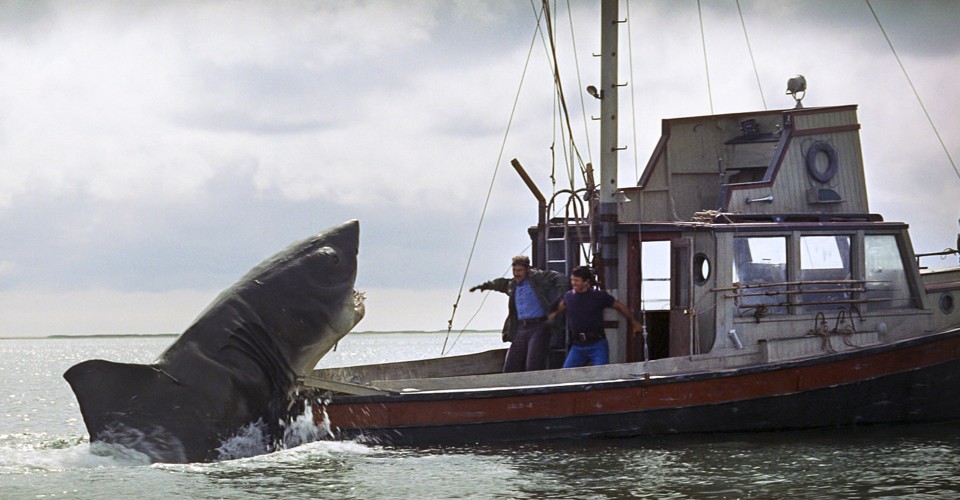

After a night of drinking Quint tells the tale of the U.S.S. Indianapolis, an American ship that was sunk in World War II. After telling the story, the men sing some drunk sailor songs (Show Me the Way to Go Home) until Jaws decides to ram the boat a few times causing the engine compartment to leak. After a quick confrontation, the shark vanishes again with Quint's boat, the Orca largely disabled. After a limited success repair attempt on the Orca, the men manage to get the shark tied to the boat, only for it to drag the boat further out to sea and causing more damage to the boat in the process. Hooper enters a shark cage and decides to face the shark in the water. Jaws makes quick work of the cage, but Hooper manages to hide in a reef. Jaws then goes full whale on the boat and breaches onto it. Quint is grabbed and eaten by the shark that again breaches onto the boat. In an attempt to get the shark to back off, Brody shoves an air tank in it's mouth. With the tank still in it's mouth the shark again goes after Brody, but he manages to shoot the air tank with a gun causing it to explode thus blowing Jaws to pieces. Hooper surfaces and the two celebrate and paddle back to shore.
For me some of the most memorable scenes from the movie include the following... Another parallel to the 1916 shark attacks is the shark entering into a pond and attacking people, including children. In 1916 Lester Stillwell, Stanley Fisher, and Joseph Dunn were attacked in the Matawan Creek, a freshwater creek located in central New Jersey. Both Stillwell and Fisher lost their lives, but Dunn would be rescued. In the movie, a sailing instructor is killed and eaten by the shark. Interesting to note that in 1916 all bodies from the attacks were recovered contrary to Jaws eating everybody. Even more interesting to me is that Jaws is a Great White whereas many scientists believe that the Bull Shark is responsible for the 1916 attacks. As a big fan of history I also fancy Quint's tale of the Indianapolis. One thing to note in that scene however is that it is believed that Oceanic White Tip Sharks were responsible for scavenging on those who were deceased or near deceased. In Quint's tale, Tiger sharks picked the men off one by one.
So where is the fun in this movie. Well it comes in knowing a little about sharks and knowing that Hollywood doesn't always equal reality. For one, some species of shark are known to breach. as you can see Jaws demonstrating in the picture above. However sharks are only known to do this while hooked and by sharks I'm generally talking about the Shortfin Mako shark which commonly breaches while hooked and sometimes lands in boats on accident. Great Whites will breach in certain part of the world, but they are not at all known to jump on the back of the boat and act like Jack Nicholson in The Shining.
In addition, sharks are not known to literally go Pacman on a boat and just start eating it's way through the boat. Nor have they proven to be intelligent enough to ram an engine compartment until it floods with water. Perhaps the most outrageous thing in the movie is at one point the shark breaches and literally roars. I'm sorry I can't think of a single shark that roars. I mean sea robins croak and what not, but never have I heard a fish of any kind let out a literal lion-esque roar. Incredible! This literally scared the crap out of people in the 1970's.
At the time that fear was justified. We knew so so so sooooo little about sharks back then that it's no wonder that this movie plunged the world into a shark panic. Now though the impacts of this movie has stretched far and wide and caused the author of the book, Peter Benchley to say "Knowing what I know now, I could never write that book today". He also said "Sharks don't target human beings, and they certainly don't hold grudges". Two huge phrases that really opened a lot of eyes to what had happened. No matter how many times Benchley said the book and film are fiction, people still feared sharks in a way they had never done before. After Jaws was released shark hunting skyrocketed. Great Whites became trophies. Some fisherman considered it doing their duty to go out and kill these animals. If you don't believe that simply go on Youtube, the videos are not difficult to find at all. Though Peter Benchley has sadly passed away, his wife Wendy continues to fight for sharks to this very day.
Partially thanks to the movie, Great White populations have plummeted around the world. Shark finning, long line fishing, trophy hunting, and fear have all contributed to this shark's populations to decrease around the world. In just over 30 years following the movie, this species of shark has ended up of the IUCN's Red List as Vulnerable. This shark is now a protected species and in some areas it seems that the populations are increasing which is amazing news. Every day more and more people are becoming aware of the truth about these animals through the efforts of individuals like Wendy Benchley and countless others who want these sharks to have a future.
Jaws is probably the most historically influenced shark movie there is. This is why this blog had a more serious tone. The upcoming shark movie blogs are a bit more outlandish as I looks towards movies such as Deep Blue Sea, Sharknado, and others. Stay tuned for some Hollywood/Sci-Fi fun coming soon!
At the time that fear was justified. We knew so so so sooooo little about sharks back then that it's no wonder that this movie plunged the world into a shark panic. Now though the impacts of this movie has stretched far and wide and caused the author of the book, Peter Benchley to say "Knowing what I know now, I could never write that book today". He also said "Sharks don't target human beings, and they certainly don't hold grudges". Two huge phrases that really opened a lot of eyes to what had happened. No matter how many times Benchley said the book and film are fiction, people still feared sharks in a way they had never done before. After Jaws was released shark hunting skyrocketed. Great Whites became trophies. Some fisherman considered it doing their duty to go out and kill these animals. If you don't believe that simply go on Youtube, the videos are not difficult to find at all. Though Peter Benchley has sadly passed away, his wife Wendy continues to fight for sharks to this very day.
Partially thanks to the movie, Great White populations have plummeted around the world. Shark finning, long line fishing, trophy hunting, and fear have all contributed to this shark's populations to decrease around the world. In just over 30 years following the movie, this species of shark has ended up of the IUCN's Red List as Vulnerable. This shark is now a protected species and in some areas it seems that the populations are increasing which is amazing news. Every day more and more people are becoming aware of the truth about these animals through the efforts of individuals like Wendy Benchley and countless others who want these sharks to have a future.
Jaws is probably the most historically influenced shark movie there is. This is why this blog had a more serious tone. The upcoming shark movie blogs are a bit more outlandish as I looks towards movies such as Deep Blue Sea, Sharknado, and others. Stay tuned for some Hollywood/Sci-Fi fun coming soon!
Sunday, July 24, 2016
New Jersey's Fintastic Visitors Episode II: The Smooth Dogfish
Hello everyone and welcome back to New Jersey's Fintastic Visitors! This will be the second installment of a series of educational blogs that highlight some of the sharks that visit my home state of New Jersey throughout the year! Today's blog will focus on a small species of shark known as the smooth dogfish!
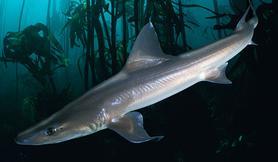
If you have ever taken a boat into the Atlantic Ocean off the coast of New Jersey and tried to fish for anything close to shore, there is a halfway decent chance that you may have caught one of these little guys. Despite their size, the smooth dogfish is just as much a shark as it's larger cousins. The smooth dogfish can grow to be roughly 5 feet in length, but the average is smaller than that. Weight wise this shark can get to be roughly 27 pounds. They make their home along the East Coast of the United States including the Gulf of Mexico and Atlantic Ocean. They can also be found along the Southern coast of Brazil and northern Argentina. Interestingly enough, the individual populations of smooth dogfish seem to keep to themselves despite migrating every year.
For the most part, these sharks are found in shallow waters, normally 60 feet or less. On occasion though they can be found in much deeper waters. On very rare occasions these sharks have been found in mostly fresh water areas, but it is thought that they cannot survive for long in those waters. The smooth dogfish is commonly confused with it's cousin, the spiny dogfish. One of the biggest differences between the two sharks, and easily the easiest way to tell the difference is that the smooth dogfish does not have the dorsal spines that the spiny dogfish has. The gestation period of this shark is roughly 11 months. The mother shark will give birth to between 4 and 20 pups. At birth, the pups are roughly 13 inches in length.
The primary diet of this shark consists of small fish as well as shellfish. The teeth of this shark is by no means adequate for tearing flesh as they are pretty flat and pavement like. This shape makes them perfect for crushing the shells of clams, crabs, etc. As a result of these teeth being the way they are, these sharks pose zero threat to man. The primary predators of these sharks are larger sharks. Hammerheads and Blacktip sharks will frequently choose dogfish as their meal.
While the dogfish is harmless towards people, people can and are having major impacts on this shark. Many fishermen consider this shark as bycatch and a problem fish. Many will simply kill this shark just because it wound up on the hook, stealing their bait. Countless other dogfish are scooped up by commercial fishing vessels and are crushed by the weight of the other fish in the nets or die from the trauma suffered while being caught. Shark finning is also affecting this shark's populations as the fins are used in shark fin soup in Asia. This shark's body is often shipped overseas cheaply as meat for Fish N' Chips as a replacement for other fish. The current population trend of this shark is currently unknown and probably varies from location to location. The most commercial fishing pressure on these sharks can be found off the northeast coast of the United States. With all the pressures these sharks are facing they are currently listed as NEAR THREATENED on the IUCN's Red List.
If you are ever out on a boat in the Atlantic Ocean and you happen to catch one of these guys or gals, take a good look at them. Keep in mind this animal is just as much a shark as any other species of shark in the Ocean. They have a job to do and they do it well. Just because this shark may have stolen your bait is not an excuse to kill it. Respect the shark and know that life can be tough for this smaller species that is dealing with a lot of pressure both inside and outside of the seas.
If you have ever taken a boat into the Atlantic Ocean off the coast of New Jersey and tried to fish for anything close to shore, there is a halfway decent chance that you may have caught one of these little guys. Despite their size, the smooth dogfish is just as much a shark as it's larger cousins. The smooth dogfish can grow to be roughly 5 feet in length, but the average is smaller than that. Weight wise this shark can get to be roughly 27 pounds. They make their home along the East Coast of the United States including the Gulf of Mexico and Atlantic Ocean. They can also be found along the Southern coast of Brazil and northern Argentina. Interestingly enough, the individual populations of smooth dogfish seem to keep to themselves despite migrating every year.
For the most part, these sharks are found in shallow waters, normally 60 feet or less. On occasion though they can be found in much deeper waters. On very rare occasions these sharks have been found in mostly fresh water areas, but it is thought that they cannot survive for long in those waters. The smooth dogfish is commonly confused with it's cousin, the spiny dogfish. One of the biggest differences between the two sharks, and easily the easiest way to tell the difference is that the smooth dogfish does not have the dorsal spines that the spiny dogfish has. The gestation period of this shark is roughly 11 months. The mother shark will give birth to between 4 and 20 pups. At birth, the pups are roughly 13 inches in length.
The primary diet of this shark consists of small fish as well as shellfish. The teeth of this shark is by no means adequate for tearing flesh as they are pretty flat and pavement like. This shape makes them perfect for crushing the shells of clams, crabs, etc. As a result of these teeth being the way they are, these sharks pose zero threat to man. The primary predators of these sharks are larger sharks. Hammerheads and Blacktip sharks will frequently choose dogfish as their meal.
While the dogfish is harmless towards people, people can and are having major impacts on this shark. Many fishermen consider this shark as bycatch and a problem fish. Many will simply kill this shark just because it wound up on the hook, stealing their bait. Countless other dogfish are scooped up by commercial fishing vessels and are crushed by the weight of the other fish in the nets or die from the trauma suffered while being caught. Shark finning is also affecting this shark's populations as the fins are used in shark fin soup in Asia. This shark's body is often shipped overseas cheaply as meat for Fish N' Chips as a replacement for other fish. The current population trend of this shark is currently unknown and probably varies from location to location. The most commercial fishing pressure on these sharks can be found off the northeast coast of the United States. With all the pressures these sharks are facing they are currently listed as NEAR THREATENED on the IUCN's Red List.
If you are ever out on a boat in the Atlantic Ocean and you happen to catch one of these guys or gals, take a good look at them. Keep in mind this animal is just as much a shark as any other species of shark in the Ocean. They have a job to do and they do it well. Just because this shark may have stolen your bait is not an excuse to kill it. Respect the shark and know that life can be tough for this smaller species that is dealing with a lot of pressure both inside and outside of the seas.
Sunday, July 3, 2016
Double Shark Sunday
Hello everyone and welcome once again. Today I will be covering two quick topics, both of which are shark related. First I'll be taking a quick look at this year's Shark Week that has come to an end. Then I will take a look at some historical events.

So I have a confession to start off this blog. I had nooooooo idea that Shark Week was actually starting on June 26th. I don't know if it's because I haven't been watching much in the way of television as of late or what, but I basically accidentally stumbled upon it. I just happened to see last year's Monster Mako was on so I tuned in and saw a countdown to the start of Shark Week. So my thoughts on this year's installment of Shark Week from what I've seen is as follows. Overall I thought this was the quietest Shark Week I've seen in years. My social media accounts weren't blowing up with it as in years past, I didn't hear people at work talking about it, and I didn't even hear much about it from local aquariums. The programming itself from what I saw, was not all that terrible. Of course you had the stupid shows focusing in on sharks hunting people and how dangerous and deadly they are. At the same time though there were actually some scientific shows that I personally found quite interesting. Sharks versus Dolphins I found to be a really good show aside from a comment about tiger sharks being man eaters. It showed quite a few different scenarios in which various species of sharks and dolphins deal with each other. It was a pretty good show and if you have any interest in sharks or dolphins, it's certainly worth checking out. The shark fin cams were pretty cool to see on different shows and really gives the audience a look at what a shark sees during the course of a day. So my overall reaction to Shark Week this year as it wraps up is better than it's been. I don't feel the need to rip different shows apart as I have in the past as many of these shows focused more on the sharks and different research as opposed to sharks doing nothing but finding ways to hunt down humans. Shark Week concludes tonight and I hope it does respectfully so. My only major gripe this year was the constant promoting of the movie "The Shallows". This movie from all previews appears to be another shark attack Jaws esque movie. At one point during a promo someone says they made the movie while respecting the shark. Seeing a massive shark breach and grab a human then stalk another for the rest of the movie is not a sign of respect. Instead it's something that just further pushes the stereotype people have for most sharks. Vicious man eaters that is...
In other, more local news to me... Two days ago was the official 100th anniversary of the start of what is commonly known as the twelve days of terror. For those of you who don't know, the twelve days of terror took place from July 1st through 12th which saw four people killed and once person badly injured by a shark. Nobody knows as to whether or not there was one or multiple sharks were responsible for the attacks. Nobody even knows for sure which species of shark was responsible. Most people believe either the great white or the bull shark was responsible for these attacks. These attacks would change the country's view on sharks forever. It is these shark attacks that the movie Jaws was modeled after. Yes it is ironic that the shark in Jaws is a great white when a great white may not have even been responsible. While the 100th anniversary is certainly something to remember and those who lost their lives should absolutely be remembered I bring this anniversary up for a different reason.
Of course the shark attacks of 1916 made the front page of several local papers over the past few days, but something else has been floating moreso around social media. That is scientists claiming this year could see a repeat of the 1916 attacks due to the amount of sharks seen close to shore in recent years. Well..... So far this year an unidentified species of shark was spotted following a pod of dolphins off of Deal New Jersey which caused the lifeguards to pull all swimmers out of the water for several hours. Today I just watched a clip of a news broadcast showing a great white that was seen roughly three miles off the coast. Of course those two reports coupled with "scientists" claiming that there is a good chance for a series of attacks this year and the 100th anniversary of the 1916 attacks has gotten a lot of people on edge. All I can say about it all is that the sighting of two sharks means nothing. Sharks are seen every year. Some are close to shore, some aren't. Last year it was a hammerhead in close to shore. Before that it was a blue shark. The list goes on and on. Point is nobody was "attacked". The scientist claims? I have zero clue what science they are using to put that statistic together. Again. There are sharks here every year. Each year goes by without problem so I'm not sure why the alarms are going off that we're in for a repeat of 1916. Lastly all the reminders of 1916 fail to be more about the lives of the victims rather than the fact that they were attacked. Many people right now are going around saying "In 1916 sharks attacked 5 people in New Jersey!" yet so many don't know who or any of the circumstances surrounding the attacks. In closing, I do not think there is any kind of elevated threat of a shark attack in New Jersey. The tiny threat remains a tiny threat as there is no real credible reason to believe that there is going to be an outbreak of attacks.
Thank you all for reading and have a safe and happy 4th of July for those of you in the USA. My next blog won't be until after the wedding on July 16th, so look for something new to pop up sometime after that!
In other, more local news to me... Two days ago was the official 100th anniversary of the start of what is commonly known as the twelve days of terror. For those of you who don't know, the twelve days of terror took place from July 1st through 12th which saw four people killed and once person badly injured by a shark. Nobody knows as to whether or not there was one or multiple sharks were responsible for the attacks. Nobody even knows for sure which species of shark was responsible. Most people believe either the great white or the bull shark was responsible for these attacks. These attacks would change the country's view on sharks forever. It is these shark attacks that the movie Jaws was modeled after. Yes it is ironic that the shark in Jaws is a great white when a great white may not have even been responsible. While the 100th anniversary is certainly something to remember and those who lost their lives should absolutely be remembered I bring this anniversary up for a different reason.
Of course the shark attacks of 1916 made the front page of several local papers over the past few days, but something else has been floating moreso around social media. That is scientists claiming this year could see a repeat of the 1916 attacks due to the amount of sharks seen close to shore in recent years. Well..... So far this year an unidentified species of shark was spotted following a pod of dolphins off of Deal New Jersey which caused the lifeguards to pull all swimmers out of the water for several hours. Today I just watched a clip of a news broadcast showing a great white that was seen roughly three miles off the coast. Of course those two reports coupled with "scientists" claiming that there is a good chance for a series of attacks this year and the 100th anniversary of the 1916 attacks has gotten a lot of people on edge. All I can say about it all is that the sighting of two sharks means nothing. Sharks are seen every year. Some are close to shore, some aren't. Last year it was a hammerhead in close to shore. Before that it was a blue shark. The list goes on and on. Point is nobody was "attacked". The scientist claims? I have zero clue what science they are using to put that statistic together. Again. There are sharks here every year. Each year goes by without problem so I'm not sure why the alarms are going off that we're in for a repeat of 1916. Lastly all the reminders of 1916 fail to be more about the lives of the victims rather than the fact that they were attacked. Many people right now are going around saying "In 1916 sharks attacked 5 people in New Jersey!" yet so many don't know who or any of the circumstances surrounding the attacks. In closing, I do not think there is any kind of elevated threat of a shark attack in New Jersey. The tiny threat remains a tiny threat as there is no real credible reason to believe that there is going to be an outbreak of attacks.
Thank you all for reading and have a safe and happy 4th of July for those of you in the USA. My next blog won't be until after the wedding on July 16th, so look for something new to pop up sometime after that!
Wednesday, June 29, 2016
New Jersey Summer 2016 Shark Blog
Ladies and gentlemen, boys and girls.... Welcome to the annual summer blog where I take a little trip into the sharks that come to New Jersey and what it potentially means for the summer beachgoers that come from all over the country, nah, all over the world. In the past I went into a lot of detail on the sharks that visit New Jersey, but since I'll be continuing the New Jersey Fintastic Visitor series of blogs, I'm going to try and post a few more pictures and less detail about these sharks since they'll all be touched on in detail later. So lets get right into this thing!
Every summer, the beaches of New Jersey are literally swamped with people. Some days in some locations, you couldn't find a spot on the sand to sit on if you tried your hardest. Yes, the beach is an incredibly popular place to be during the summer and so is the ocean. What many beachgoers are completely unaware of is that New Jersey is a sort of hot-spot for sharks. Now before hysteria happens.... Despite many species of sharks visiting New Jersey, attacks are incredibly rare. In fact the last fatal shark attack in New Jersey was back in 1926. Some of the shark species that visit New Jersey are shocking to say the least. Some are small, some are large, but the bottom line is this. Each and every one of the species deserves our highest respect as they are the kings and queens of the oceans and we are in their domain whenever we step foot into the ocean.
Some key things to remember is that sharks are not the monsters that the media portray them to be. These animals have been known to peacefully swim alongside humans more often than not. Divers are in constant contact with these animals and it's only once in a blue moon that you hear about a shark biting a human. Another thing to remember is the simple anatomy of the shark. Sharks don't have a sense of touch like we do. They can't reach out with their fins and get a feel for strange objects. Instead, their sense of touch is literally in their mouth. This is why you hear occasional stories of a shark seemingly chewing on a dock or a corner of a boat. They're trying to figure out what the object is, not trying to eat the object. I'm not going to go into the full details about what sharks do when their really trying to eat here. Another key thing to remember is when these animals are the most active. There is a general rule of thumb that these animals tend to be more active in the evening and in the morning. Another key to remember is that many large species of shark tend to pick off stragglers of groups. Expanding more on that key point. Many large species of shark, including ones I'll be looking at soon, are known to go after seals. The thing to remember is that surfers look like seals. Think about it. Seals have a long body similar to a surfboard. They have to front flippers similar to arms hanging off a surfboard and likewise the feet. The final key point is what has led to many shark attacks around the world. It's known as a case of missing identity. The shark bites a person and is then gone. Very, very rarely does a shark return for another bite. So with all of that being said....
Sharks are all over the world. It doesn't matter what beach you swim off of, sharks are there. That being said, there is no need to fear these animals. Respect them at all times. Respect that you are in their world. Understand that they are not like us and that many shark "attacks" are either cases of mistaken identity or a curious shark is simply trying to figure out just what a strange being in their water is. Respect when they are the most active and your swimming will be a real blast here in New Jersey. Even if you swim in the evening or the morning, your chances of being bitten by are shark are astronomically small to almost non existent. They just tend to be more active at these times. So lets look at some of our visitors!

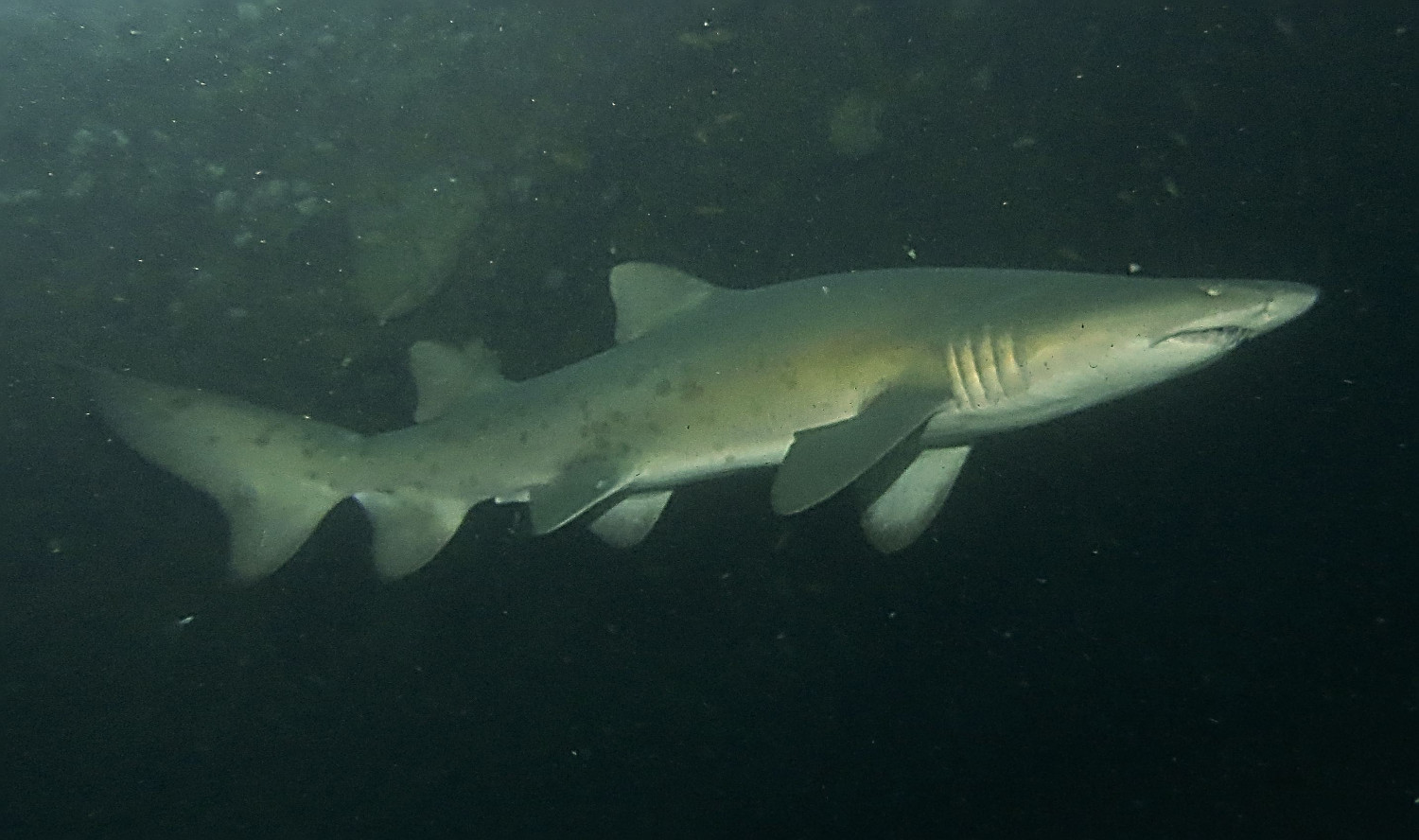


Every summer, the beaches of New Jersey are literally swamped with people. Some days in some locations, you couldn't find a spot on the sand to sit on if you tried your hardest. Yes, the beach is an incredibly popular place to be during the summer and so is the ocean. What many beachgoers are completely unaware of is that New Jersey is a sort of hot-spot for sharks. Now before hysteria happens.... Despite many species of sharks visiting New Jersey, attacks are incredibly rare. In fact the last fatal shark attack in New Jersey was back in 1926. Some of the shark species that visit New Jersey are shocking to say the least. Some are small, some are large, but the bottom line is this. Each and every one of the species deserves our highest respect as they are the kings and queens of the oceans and we are in their domain whenever we step foot into the ocean.
Some key things to remember is that sharks are not the monsters that the media portray them to be. These animals have been known to peacefully swim alongside humans more often than not. Divers are in constant contact with these animals and it's only once in a blue moon that you hear about a shark biting a human. Another thing to remember is the simple anatomy of the shark. Sharks don't have a sense of touch like we do. They can't reach out with their fins and get a feel for strange objects. Instead, their sense of touch is literally in their mouth. This is why you hear occasional stories of a shark seemingly chewing on a dock or a corner of a boat. They're trying to figure out what the object is, not trying to eat the object. I'm not going to go into the full details about what sharks do when their really trying to eat here. Another key thing to remember is when these animals are the most active. There is a general rule of thumb that these animals tend to be more active in the evening and in the morning. Another key to remember is that many large species of shark tend to pick off stragglers of groups. Expanding more on that key point. Many large species of shark, including ones I'll be looking at soon, are known to go after seals. The thing to remember is that surfers look like seals. Think about it. Seals have a long body similar to a surfboard. They have to front flippers similar to arms hanging off a surfboard and likewise the feet. The final key point is what has led to many shark attacks around the world. It's known as a case of missing identity. The shark bites a person and is then gone. Very, very rarely does a shark return for another bite. So with all of that being said....
Sharks are all over the world. It doesn't matter what beach you swim off of, sharks are there. That being said, there is no need to fear these animals. Respect them at all times. Respect that you are in their world. Understand that they are not like us and that many shark "attacks" are either cases of mistaken identity or a curious shark is simply trying to figure out just what a strange being in their water is. Respect when they are the most active and your swimming will be a real blast here in New Jersey. Even if you swim in the evening or the morning, your chances of being bitten by are shark are astronomically small to almost non existent. They just tend to be more active at these times. So lets look at some of our visitors!
Starting off pretty famous here. The great white shark is a visitor to New Jersey every year. In fact there is a large tagged female great white that migrates right up the cost every year. The shark's name is Mary Lee and she at this point is the bringer of summer and winter as she migrates past the state in the spring and fall. Other great whites also come by the shore quietly every year as well. Historically speaking, the great white is blamed officially for zero attacks in New Jersey. There is a lot of controversy as to whether or not the great white was the shark involved in the famous 1916 shark attacks in New Jersey. The major controversy lies in that the shark was never actually seen and a couple of the attacks took place in brackish water, an area that great whites typically don't venture into. Either way, great whites can be very aggressive but they are not not known to eat people. Nearly every time a great white has bitten someone, it has vanished instantly. Point in case, these animals are not man eaters, but just another visitor to the Jersey shore. They're rare, but they do come around every year.
On the other end of the spectrum is the little smooth dogfish. This shark is a fisherman's nightmare. Countless fishermen catch these little guys while trying to catch a variety of bony fish. This shark is basically harmless. Besides the fact that they are small, they have very tiny teeth that are more like pebbles than actual teeth. There is nothing to fear from these little guys as they swim around picking off shellfish and crustaceans. They have been known to cause some panic from many uneducated beachgoers that somehow mistaken them for baby great whites and other large species of shark.
The sand tiger shark is the most commonly seen species of large shark and is easily one of the more ferocious looking. One of the more popular aquarium sharks, the sand tiger is also known as the ragged tooth shark and the grey nurse shark. These sharks are usually slow swimming and frequently tolerate divers swimming right along side them. When startled, these sharks can produce an incredible, short lived, burst of speed. In fact they can whip their tales so hard that a void in the water is created and the collapse of that void sounds like thunder. Most impressive! The sand tiger is best known for it's crazy array of teeth that are visible at all times. The well known law when swimming with this shark is to respect it at all times and it will be very tolerant. As with any animal, harass it and it may not be so tolerant. The sand tiger shark cannot legally be targeted by fisherman due to it's conservation status. These sharks are most commonly found around structures such as ship wrecks and are much more active at night than during the day.
If you're looking for a really crazy looking shark in New Jersey, look no further. Believe it or not, New Jersey is visited by scalloped hammerheads when the waters warm up. These sharks are extremely sensitive to it's surroundings and tend to shy away from humans. Over the past couple years, scalloped hammerheads have been seen very close to shore looking for small fish, rays, and crustaceans to eat. Despite their size and aggression towards their prey, these animals have never bitten a person in New Jersey's waters. Personally the hammerhead is one of my favorite sharks and I find it to be quite the fascinating animal. If you have the time and want to see something truly amazing, head on over to youtube and look up some videos of these sharks hunting or even just swimming. Some real awesome stuff there! Seeing these sharks in New Jersey's waters is a real treat as it is an Endangered Species in desperate need of protection.
Boaters beware!!!! New Jersey sits at the northern tip of the whale shark's range. The largest fish in the world will on rare instances visit the waters off of New Jersey. They are by no means frequent visitors, but none the less... The fish with the four foot wide mouth can at any time show up and swallow a person in one gulp... One problem. The throat of a whale shark is roughly the size of a quarter so no worries, this shark can't eat you. Top it off with this... The whale shark has never once bitten a human or even harmed a human. In fact the most whale sharks have done to humans involve stealing fish out of a net and pushing a boat. If you are on a boat this summer and see a spotted fin sticking out of the water. Consider yourself incredibly lucky, you could have just stumbled upon a whale shark!

The sandbar shark is another larger species of shark that inhabits the waters of New Jersey. This shark can be found in varying depths of water and have been known to come very close to shore. These fast moving sharks are very skittish and despite their size, tend to only go after small to medium sized fish. These sharks, along with the dogfish, are often mislabeled as sand sharks (fun fact: sand sharks don't exist). This species of shark is another one that has been known to cause a bit of panic among beachgoers as they have a very large dorsal fin that can be mistaken for a great white if you are unfamiliar with sharks. As is the case with the other large sharks I've mentioned, there is no recorded attack by a sandbar shark in the state of New Jersey. That being said, I don't have any information about whether or not these sharks have bitten any fishermen who've caught these sharks. In that case though I certainly don't blame the shark and I hope no-one would.

Another offshore shark that will from time to time venture inshore is the porbeagle. It looks like a great white, but it's not. It's only on rare instances that these sharks have been seen close to shore. Much like the great white, this shark is partially warm blooded, so they can venture into cooler waters where some other species of shark cant. Also, much like the great white, this shark has seen it's population decrease due to intense fishing. The porbeagle is currently a protected species and one of New Jersey's lesser known visitors. Common theme: There is no record of a porbeagle biting a person in New Jersey.

The highly migratory blue shark will swim by the Jersey shore during the summer months. Sometimes these sharks make their way into shallow waters as one was seen basically surfing through the waves a few years ago. These sharks can be aggressive, but as is the case with the other larger sharks, the blue shark has never bitten anyone in the waters of New Jersey. These sharks are really quite fascinating as they will cross the ocean many times throughout the course of their lives. In addition, unlike most sharks, the blue shark is known to swim in schools. Strength in numbers!

The thresher shark is another offshore species of shark that visits New Jersey. This shark will stun it's prey by smacking it with it's oversized tail making it an easy meal. Legend tells of fishermen who were beheaded by the tail in intense battles with these sharks. Of course that is just legend and there is no actual account of a person being beheaded by a thresher shark. In fact, thresher sharks are not known to be aggressive towards humans at all, unless of course they are on the end of a fishing hook. No, the thresher would much rather smack some small fish around to snack on. Seeing on of these sharks close to shore would be rare as they tend to inhabit deeper, cooler waters.

Speaking of offshore... The shortfin mako shark will also visit New Jersey during the summer months. Much like the thresher and porbeagle, to see one of these sharks close to shore would be surprising to say the least as they enjoy the cooler, deeper waters off the coast. Shortfin makos are an incredibly powerful species of shark that is capable of launching itself 30 feet out of the water. They can also swim at speeds nearing 60 miles per hour. The shark is specially designed for both speed and power. The ambush ability these sharks have is simply amazing. Since they rarely come in contact with humans these sharks tend to be forgotten by folks swimming in the shallows. Still, they are another large visitor to New Jersey. Much as is the case with other sharks listed. There are no recorded attacks on swimmers, but they tend to become very aggressive towards fishermen who have them hooked. Sometimes they have been known to launch themselves onto a boat, injuring the fishermen in the process. Due to overfishing the population of the short fin mako is in decline with less and less large makos seen each year.

The bull shark is another controversial shark that will inhabit the waters of New Jersey. Unlike many of the other large species of shark, the bull shark will come very close to shore and can be very aggressive. This species along with the great white are the two sharks that have been mostly commonly looked at as the sharks responsible for the 1916 New Jersey shark attacks. Many people believe that a bull shark may have been responsible for the attacks as they are known to move into fresh water and brackish water areas. In fact the bull shark has been spotted as far inland as Saint Lois in the Mississippi River. In New Jersey, these sharks are not commonly seen and there has been no confirmed attacks by a bull shark in New Jersey's waters. As is the case with many of the other sharks in New Jersey, this species of shark is currently seeing a population decline.
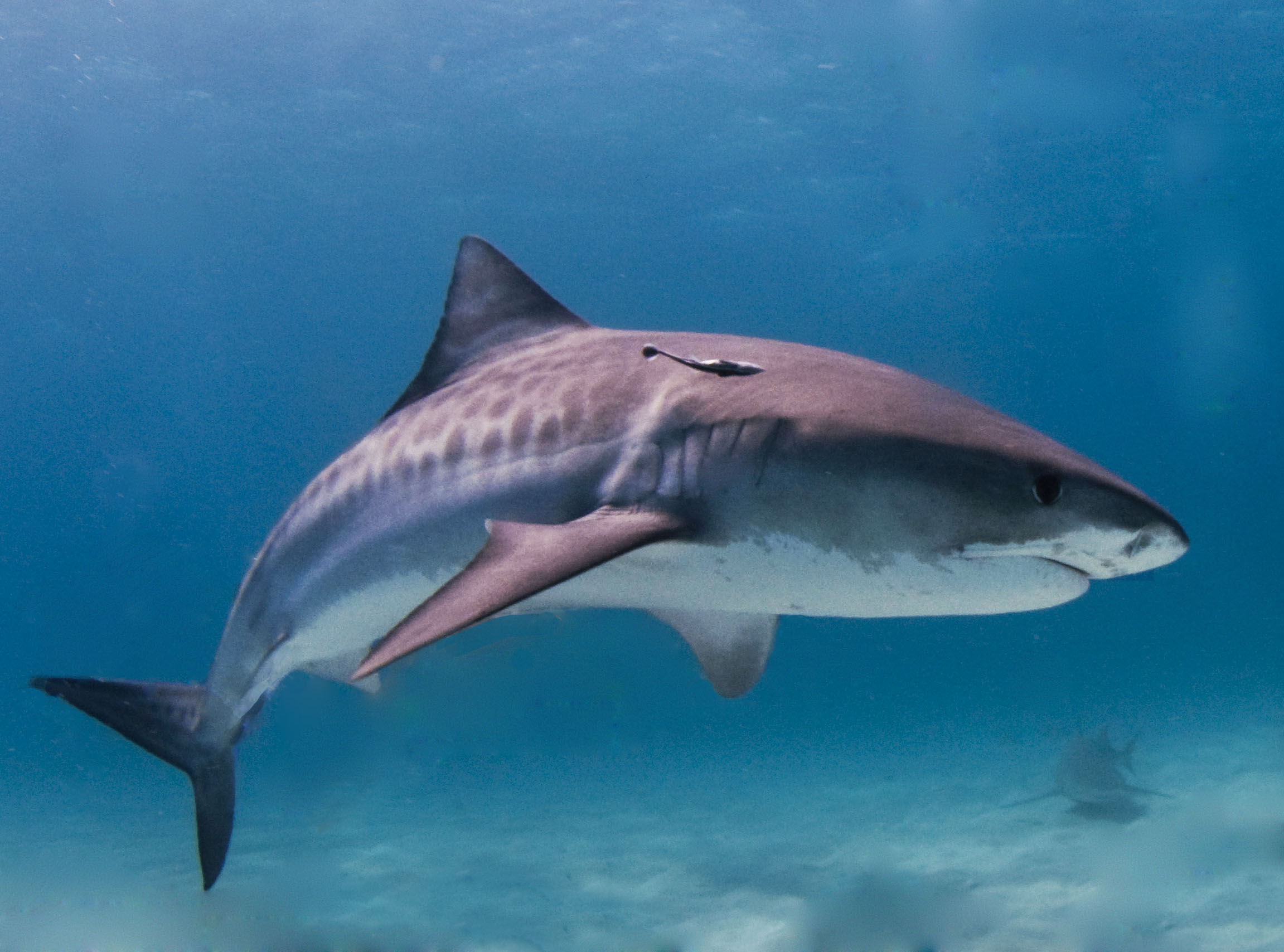
The list seems endless doesn't it? The next shark is the tiger shark. This is another large species of shark that can be quite aggressive. Many people refer to these sharks as living trash cans as all kinds of random stuff (licence plates for example) have been seen inside these animals. The tiger shark is known to be aggressive, but as is the case with nearly all sharks off New Jersey, there is no confirmed attack by a tiger shark.
I'm going to stop the list there. I will say that more species than the ones I listed visit New Jersey during the summer months. The main point to look at is this. Out of all these sharks, including many well known species, only 2 of them have ever been suspected of biting a human unprovoked. That number folks dates back to the 1500s. It is very, very safe to swim in the ocean off of New Jersey (outside of rip currents, etc). If you come to the beaches here, do not fear the ocean because of the sharks. These animals are at the top of their food chain. They hunt anything from crabs to seals to even dolphins. Humans are simply not on the menu. Mistakes happen. Look how many mistakes we make on a day to day basis. It happens. It happens for sharks too. Cases of mistaken identity are mistakes. Nothing more. Yes, the mistake can cause a lot of damage, but that is the end result of a large animal biting a small animal. In the end, these animals are really just as every bit curious of us as we are of them. We are in their world in the oceans.
I'm going to stop the list there. I will say that more species than the ones I listed visit New Jersey during the summer months. The main point to look at is this. Out of all these sharks, including many well known species, only 2 of them have ever been suspected of biting a human unprovoked. That number folks dates back to the 1500s. It is very, very safe to swim in the ocean off of New Jersey (outside of rip currents, etc). If you come to the beaches here, do not fear the ocean because of the sharks. These animals are at the top of their food chain. They hunt anything from crabs to seals to even dolphins. Humans are simply not on the menu. Mistakes happen. Look how many mistakes we make on a day to day basis. It happens. It happens for sharks too. Cases of mistaken identity are mistakes. Nothing more. Yes, the mistake can cause a lot of damage, but that is the end result of a large animal biting a small animal. In the end, these animals are really just as every bit curious of us as we are of them. We are in their world in the oceans.
I've spent a good amount of time talking to fishermen and divers living along the shore and the story is the same. Respect them and they'll respect you. Divers have seen tiger sharks, as well as nurse sharks hanging near an inlet. Fishermen have seen makos breach 20 plus feet in the air and land safely back in the water. Boaters have seen a great white slowly swim up to bump a boat and go about their business. Swimmers have seen hammerheads, blue sharks, and sandbar sharks tearing through the surf without incident. Point in case. None of these animals cared in the least bit that a person was in the water with them. I can't say it enough. Show the shark respect and he or she will in all likelyhood show it back. So get out there and enjoy the ocean. Don't worry about sharks, but if you happen to see one consider yourself lucky. They are always in the ocean, but rarely seen.
If you were hoping to see more information on these species of sharks, stay tuned as later this summer I'll be highlighting many in their own blog as part of the New Jersey Fintastic Visitors blog series. I'm hoping to get one more blog out, possibly about Shark Week, before the wedding! If by some chance I can't get to it until after, then I hope all of you have a great time until return in late July :)
If you were hoping to see more information on these species of sharks, stay tuned as later this summer I'll be highlighting many in their own blog as part of the New Jersey Fintastic Visitors blog series. I'm hoping to get one more blog out, possibly about Shark Week, before the wedding! If by some chance I can't get to it until after, then I hope all of you have a great time until return in late July :)
Subscribe to:
Posts (Atom)