Saturday, August 10, 2013

Shark Week Blog 3: The End of Shark Weak

Shark Week this year has, in my honest opinion ruined Shark Week entirely for me. The more I watch, the more I've come to realize that Shark Week is not the Shark Week I grew up watching. Growing up, I didn't know much about sharks. Frankly I was willing to watch Shark Week and accept most of it as fact. I have several Shark Week DVDs in my personal collection and I still pop them into my DVD player from time to time and now knowing far more than I ever did about sharks, I came to the conclusion that a lot of it is exaggerated, but the scientific content was largely true. This year though, the new shows have done nothing but disappoint me time and time again.

The show on Megalodon was interesting for sure, but it was not a true documentary. There were no whales washing up with massive bites. There was no boat that mysteriously sank. To top it off the "researchers" turned out to be nothing more than paid actors. Meaning that Shark Week kicked off with a sci-fi movie. Not surprising, Discovery Channel on their website had a poll as to if Megalodon exists. Over 70% of the people said yes after that show aired. Discovery literally crammed false information down our throats and now there is a massive wave of people who are fearing a creature that for all we have known for a long time, doesn't even exist. I've read several articles claiming that with this show, Discovery has jumped the shark sort to speak. I tend to agree with that.

The shark after dark show is just an absolute joke. I've watched it twice and I think I've learned literally nothing about sharks. I feel like this show is nothing more than a very, very poor attempt at trying to bring the magic that other after shows such that Deadliest Catch and The Walking Dead have. Seriously though, when this is a part of that show, nothing about it can be taken seriously.
http://www.youtube.com/watch?v=9CNwrEtrYFM

The scientific "facts" that the shows have been stating have also severely disappointed me. Just off the top of my head, two instances of me putting the palm of my hand over my face were as follows. In discussing what great white sharks eat, the video was of sea lions swimming around. The narrator called them Pacific harbor seals. I work with seals. The things on the T.V. were by no means seals. Now though, an unknown number of people think that Pacific harbor seals and sea lions are the same thing. Another instance was when they were listing different species of shark that live in a certain area. The video showed several different species of shark, but not the bull shark. Rather they showed lemon sharks as bull sharks. Again, a totally different animal. As small as these things may seem, they shouldn't be happening. Discovery Channel claims that Shark Week is all about education and conservation. The last time I checked false information is not educational at all. If I didn't know any better and I was someone living in say, the desert, I would potentially have never seen a real seal. So by watching Shark Week I would have learned that seals and sea lions are the same thing. That's just fantastic isn't it? Conservation? From what I watched the only hints of conservation were embedded so deeply in all the blood and gore of the week that they were not noticable in the least bit. Not once did I see any form of ad or statement saying that roughly 100,000,000 sharks are being killed every year. Not once did I see any form of explination on what shark finning or long line fishing are. Discovery, if you want to say Shark Week is about conservation, step up and deliver. Don't sit there and say one thing and do another. You want controversey? Try playing a documentary like Sharkwater as opposed to that horrific Megalodon show and you'll get a controversy that actually matters.

I was hoping that Shark Week would be one week that Discovery Channel actually got away from reality T.V. and went back to it's roots and actually educated people on something that matters. I wish I could say that I am surprised, but I'm truly not. Year after year, Shark Week has been getting more and more away from the point that it claims to be making. The point being that the week is all about conservation and getting the truth about sharks out in the open. If that was the case, I wouldn't have to be typing this blog. If that were the case I wouldn't have both friends and family thinking for sure that an animal that has been extinct for millions of years sudenly has come back and is hunting humans. I wouldn't be having to tell people that seals and sea lions aren't the same thing. I wouldn't have to do a lot of things if Discovery would look at it's programming and choose what it actually wants to put out. If they want Shark Week to be a sci-fi horror show along with mockumentaries, then put it out there that that is what it is. Not educational or factual, just another week of terrible shark shows that do nothing but instill fear and hatred in people for these animals.

On a scale of 1-5 I personally would give this year's Shark Week a weak 1 out of 5. The shows were largely lacking and not for nothing, but some of the information was just flat out untrue. Afterall. How can a shark be on a top 10 deadliest list without killing a single person? Makes no sense to me. This was easily the worst Shark Week I've ever seen and I have a feeling that next year will stick to my DVDs and watch actual informative Shark Week shows as opposed to the wannabe reality/sci-fi garbage that was on my T.V. for the past week.

Tuesday, August 6, 2013

Shark Week Blog 2: The Glory of it All

Shark Week is known for instilling excitement, wonder, fear, and fascination in people and their feelings towards sharks. Last night, Discovery Channel aired a, what I found to be pretty interesting show entitled "The Return of Jaws". The show focused mostly on a group of researchers who used some ground breaking technology to follow great white sharks just off the coast of Chatham, Mass. The team used a robotic submarine camera to follow large great whites to study just how close these animals are coming to shore.

Surprising to some, New Jersey is home to seals in the winter time. What does this have to do with anything? Quite a bit actually. During the fall, great white sharks migrate from the north down to Florida. During that time, the seals migrate from the north down to states such as New Jersey, which is why during the fall, there are often several great whites spotted off the Jersey Shore. During the spring as you might be able to guess, the opposite happens, the seals move north and the sharks follow. The summer home of both sharks and seals in areas such as Chatham has caused more and more people to become wary about swimming in those waters. This is where these researchers come in.

Using that robotic sub, the researchers were able to see great whites swimming in as little as 3 feet of water while stalking seals. It was really interesting to see how these animals on a daily basis appeared to move up and down the coast, not bothering any people whatsoever. Then, of course, is where the show changes and that need to not just be an interesting documentary shows up. The screen turns to a flashing ambulance light as a swimmer was bitten by a shark off of Chatham. The show that had virtually nothing to do with shark attacks, except for the occasional mention that these studies could potentially help beach patrols make beaches safer, suddenly became focused on a very minor shark attack. The person who was bit by the shark received, if memory servers, 24 stitches. No severed limbs or anything like that, just one bite and the shark was gone. Of course there was no mention of there being just one bite and the shark vanishing. That final few minutes of the show once again brought into light what I think the real reason for Shark Week is.

At this point I believe that Shark Week is a week long Hollywood wanna be program. Virtually every show makes mention of the name Jaws and even if it doesn't, in some shape or form, it involves sharks biting people. There are a few exceptions to this, but for the most part, these are facts, just take a look at the names of some of this year's Shark Week Programs. The Return of Jaws, I Escaped Jaws, Spawn of Jaws, Sharkpocalypse, The Top 10 Deadliest Sharks. Where in those names is there even a hint that there will be some form of education to be had? Nowhere. Obviously that wouldn't make people tune in, so titles that sound like B level Sci-Fi movies are used and sure enough, the audience is drawn in. It is no secret what the movie Jaws did to the reputation of sharks around the world. That damaged and undeserved reputation continues to stick in the minds of many people and Discovery Channel is doing nothing to help ease that by naming these shows in this way. The content of the shows themselves aren't much better than their names. Lots of blood, lots of attacks, and a wee bit of science and an occasional 15 second conservation thrown in to try and make everyone happy. It's not hard to figure out what the intended audience is though. It's not the people who are interested in learning the truth about sharks, that is evidenced twice already this year by taking a very interesting show about tracking great whites and giving it a pretty frightening name and throwing in shark attacks. It is also evidenced in the Megalodon show as many of the images and "video" appear to not even be real. If those people had video proof of Megalodon, do you think it would still be labeled extinct?

It is understandable from a business standpoint as to why Discovery would market Shark Week in this fashion. I'd be shocked if even a quarter of the people who watch Shark Week on a nightly basis would tune in if there was no blood, no violence, and no cool show names to lure them in. At that same time, there is so so much more Discovery could be doing to help promote shark conservation through the week. For example, how much would it realistically cost to put up graphics at the end of a show that states a truly harrowing fact? That by the end of Shark Week, up to 4,500,000 sharks will be killed. Would it truly be so hard for Discovery to do that? Why can't Discovery do more than show a 15 second conservation message (to which I have yet to see this year) about finning? If Discovery truly had any interest in protecting these animals they wouldn't be so quick to make them out to be such monsters. Shark Week rolls on tonight with two more shows featuring Jaws! One can only assume that these shows will further instill fear into people and make them want to never go into the Ocean again, but more importantly, instill fear for an animal that has done nothing to warrant the reputation that has been forced upon it.

Monday, August 5, 2013

Shark Week Blog Number 1: Mega Mystery

Ok everyone. Originally I was going to do a Shark Week Review at the end of the week, but I figured I'd pick a few shows to review. What does this have to do with conservation you ask? Don't forget that the media does play a substantial role in why so many people are afraid of sharks. So even though these blogs won't exactly be focusing on 100% real issues, they, just like any other sci-fi show can affect people. So without further delay. Here is what I thought about a pretty interesting show entitled Megalodon: The Monster Shark Lives.

I want to start off by saying that this show reminded me of a documentry with a sci-fi/horror twist. The interviews in some cases were mildly creepy I thought complete with some eerie music and a black and blurred background. Anyway the show itself brought up an interesting question. Does the ancient fish known as the megalodon exist today? For those of ou who did not catch the show and have no idea what a megalodon is I'll briefly explain it to you. While we have no skeletons of the ancient fish known as the megalodon, scientists believe that the animal grew to be over 65 feet in length. That is more than 20 feet longer than the current largest fish in the world, the whale shark. The jaws of this animal, needles to say were also quite massive as fossilized megalodon teeth have been found, some being about the size of an adult human hand or bigger! This predator would have been able to eat pretty much anything it wanted to including whales. Chances are, outside of other megalodons, the megalodon had no real predators. Getting back to the show.

The whole show was based off a mysterious sinking of a boat off of South Africa, one of the world's great white hotspots. Apparently whales had also been washing up on shore with massive bites taken out of them around the same time that this boat sunk. Personally I don't think these bites were from the ancient fish. In South Africa, and other parts of the world, great white sharks have been known to dine on large whale bodies together. There is evidence of this in several other Shark Week programs where video is actually taken of the sharks doing this in groups. To me, the photos that the show displayed claiming to be megalodon bites looked a bit photo shopped, but I could be wrong. If that's the case, then I believe that those bites were probably from a group of white sharks doing what they do best. Either way, I feel that if megalodon was really near South Africa, somebody would have by now gotten some kind of actual picture of the creature or at the very least a credible camera would be able to pick up on it. Now for the ultimate question... Is megalodon still alive?

It's really a loaded question. From time to time animals show up that we thought went extinct long ago. The Colecanth and Giant Squid are two examples of animals that for a long time people believed to not exist anymore. Strangley enough both of these animals and another known as the megamouth shark all inhabit the same area of the sea, the deep Ocean. If and that's a big if megalodon still exists today then in my opinion, that is where he would be. In the deep Ocean. I do not think it would be the same megalodon that inhabited the Earth millions of years ago, but one that has adapted more to life in the deep Ocean. If you think about it, millions of years ago, megalodon would have been eating large fish and even dinosaurs and the first whales. Well below the surface we know that there are large animals. There are large sharks, squids, whales, and various other giants that would probably make a real meal for megalodon. Personally I am not looking much into megalodon still existing today. As much as I would love to hear news someday that this creature still exists in the deepest parts of the Ocean, I just don't see it happening. Still though that's just another part of the mystery of the Ocean. In total we've only explored roughly 5% of the world's oceans so again, anything is possible.

As for Megalodon: The Monster Shark Lives. I think it was a well thought out show that really brought back the question as to if megalodon still exists today. The way in which they go about doing it though I feel was a bit too sci-fi for what was I think supposed to be a convincing documentary? I'm not really sure what the show was going for, but again that very real question was flung back into the light. Sadly though if things keep going the way they are in the oceans, we will probably never know if megalodn still exists because even if it does now, it wont soon. The modern day sharks are being wiped off the face of the Earth and while this at this time wouldn't effect megalodon if it's alive, when the oceans fall apart and the oceanic climate goes through rapid and dangerous changes due to sharks being killed off, it certainly would.

Does megalodon exist? Perhaps it does. Perhaps it doesn't. There is no evidence saying it does, but then again, there is no evidence in my opinion that it doesn't largely thanks to humans only exploring about 5% of the oceans. I can say for sure though that if we as humans do not step up and save our oceans, the answer to the question will be a big fat NO along with any other species of fish, marine mammal, marine reptiles, aquatic birds, and just about any animal, including humans that live on land.

Wednesday, July 31, 2013

Shark Slaughter Planned for Reunion Island and Shark Summer Stuff

Good evening everyone. I hope everything is going well with you all. Again, I apologize for the lack of blogs. My personal life has been taking a very big turn so my mind and physical existence has just not been at the computer much. Anyway... I would like to start off by directing you all to this story that has come out from Reunion Island. http://www.grindtv.com/action-sports/surf/post/reunion-island-bans-surfing-plans-massive-shark-kill/

The response to these attacks are nothing more than complete insanity. First of all, any human who enters the Ocean is stepping into the world of sharks, seals, dolphins, whales, etc, etc. The Ocean is NOT the world of humans. Humans frequently visit that world as seals visit our world to rest on the beach. We as humans have no right to say whether or not sharks should be allowed to live in certain areas. The bottom line is simple. Sharks have lived off of Reunion Island for much, much longer than humans have lived on the island. The island is home to two aggressive species of shark. The bull shark and the tiger shark, which as the article stated are being targeted for extermination. These two species of shark can also be found along the East Coast of the United States. They are aggressive, large sharks that are known to not prey on humans, but to accidentally bite surfers by mistaking them for seals, turtles, and other animals. Reunion Island needs to seriously take a look at the situation that they have on their hands and strongly consider the consequences of killing these animals.

For one, the shark populations off of Reunion Island probably not as well known as they are in other parts of the world. For all we know, it could be several small populations and that's it. Eliminating even a small number of those apex predators can have devastating consequences to the local ecosystems. The ecosystem around Reunion Island is apparently growing and it should be allowed to continue to grow. The sharks are there for a reason. Kill them and the ecosystem will fall out of balance and eventually implode. Reunion Island's response is going to do nothing for them either. They'll kill the sharks and what will happen? Chances are another surfer will at some point get bit. Then what? They'll kill more? There has to be an alternative to what they are doing.

From what I can see, it shouldn't be too difficult to establish a system where surfers, and swimmers in general for that matter off of whatever beaches these attacks are taking place to have a swim at your own risk sign. Have the shark warning signs, but make it abundantly clear to surfers that if they enter the world of sharks, they enter it with each other and that's it. The surfers are generally aware of that and many understand the risk that they are taking by paddling out. In fact some of the biggest conservationists in the world have been bitten by a shark and now dedicate their lives to saving that which bit them. So I really fail to believe that surfers would reject the idea of still being able to surf at Reunion Island even if it is a surf at your own risk area. People aren't going to stay away from the Reunion Island beaches. The thought of that is frankly stupid. Look anywhere else in the world... Florida, Australia, and South Africa come to mind where sharks are abundant. Do people stay away from those beaches? Sure a few people here or there might, but the vast majority still make it a point to get to those locations if possible. So the idea that the sharks may cause some kind of economic collapse is literally nothing more than an idea, and a poorly theorized idea at that.

Reunion Island needs to call off this senseless slaughter of the sharks. The justification is that there will be scientific research done. I have strong doubts that will actually be the case. There are plenty of slaughters that take place in the name of science, yet no scientific results ever come out, yes I'm looking at you Japan... Again, Reunion Island needs to back off of this archaic idea of killing sharks to make the Ocean safer and look into alternative ways to making their beaches safer or allow those who want to risk a swim to take that risk into their own hands.

So this summer is really shaping up to be an interesting summer when it comes to sharks here in New Jersey. Our neighbor to the North, New York has passed a law that will come into effect on July 1st, 2014 that will ban the sale, possession, and trade of shark fins. This law is very similar to the laws that have been passed by several other states, including Delaware, New Jersey's neighbor to the south. Needless to say what I am getting at here. New Jersey needs to join her neighbors and become a fin free state. In fact, you can check out Shark Angels and learn all about what you can do to help going about making New Jersey fin free!
alt
 http://sharkangels.org/index.php/get-involved/fin-free/fin-free

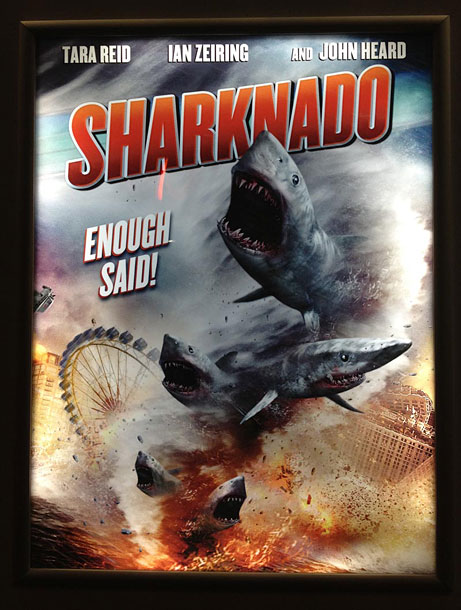
Next we have that Sci-Fi movie train wreck known as Sharknado. I personally have not seen the movie yet, but I hear that is is absolutely terribly good. One of those movies that are so bad, they're good kind of deal. I mean the movie poster really says it all...


I mean literally, it's a tornado of sharks.... Anyone who takes this movie seriously and becomes afraid of sharks as a result needs to take a step back and realize just what you are watching. From the looks of it, I'd say this is a combination of these two movies...


Seriously, this movie should not be taken for anything more than the Sci-Fi train wreck that it actually is. Sharknado II is supposed to be coming out eventually and is going to take place on the East Coast, possibly New York. Again, people I beg of you do not let these terrible films dictate your feelings towards these animals. No shark is going to be tossed from a tornado and proceed to eat you. It's just not going to happen...

So the final topic of the evening now that that train wreck is out of the way... New Jersey has seen several great white sharks come by. Two of which were actually filmed on camera. Both were seen off of Atlantic City. Neither shark attacked a person. One shark was seen um...... "Attacking" a dead dolphin...... Which I'll come back too.... The other gently bumped the boat the people were on and then left. Now I want to clarify something that the media is trying to blow up by using the word "attack"... I know this may be hard to believe, but sharks eat dolphins. Sharks are scavengers as well as predators meaning sharks will eat dead dolphins. In New Jersey, we are currently having a huge problem in which dolphins are being killed by commercial fisherman, literally, one was found with a gash from it's throat to it's stomach. To a great white, that's a nice meal.

Correct me if I am wrong. When we say an animal is attacking another animal, normally we mean that there is some form of intent from one animal to injure or consume the other. When the animal is dead we normally say, the animal proceeded to eat the other animal. So all over the news today i see... Shark attacking dead dolphin... I'm sorry, but what now? Try shark filmed eating a dead dolphin. The shark isn't trying to injure or kill a dead animal. That word "attack" when it comes to sharks is so misused, it's almost sickening. The only thing that sharks truly attack are living large fish, small fish, shell fish, marine mammals, marine birds, etc. See where I'm going with this. Scavenging and attacking are far far apart, but low and behold the media uses that word attack and instills fear of sharks yet again.

Thank you all for reading once again. Sorry again for the delay and lack of blogs, but I am trying and more will be up soon. So until then... Stay tuned!


Wednesday, July 17, 2013

Operation Forgotten Update

Hello everyone, I hope you all are doing well. This blog is a little update as to what is going on with Operation Forgotten. It's been about 10 days since my last blog and here is why it's been a while. My life has gotten a little hectic as of late. Between work and other issues, I have simply not had the time to type. After this weekend, hopefully things will settle down a bit and I'll be able to get this thing going full force again. I apologize again for the lack of blogs, but trust me, I will get things going again very soon.

Expect to see new blogs on sharks, manta rays, and bluefin tuna in the very near future!

Monday, July 8, 2013

Without Sharks What Are We?

Humans are clearly the dominant animal on the planet. We have so much technology, so many thoughts, and frankly, there is a lot of us crammed on this small rock. Regardless as to what your personal beliefs are, there is one thing that is true. It is probably going to be hard to believe for some of you at first, but hopefully by the end of this blog it will be clear. That fact is that without sharks on this planet, mankind will die. All the technology in the world will not be able to save us once the apex predators of the sea are wiped out. The ocean is dying. Sharks are being killed at an incredibly alarming rate and the consequences of these actions are starting to be felt.

At the core of how to animals in the ocean keep the ocean alive and well has a lot to do with the food chain. Here's a rough idea of the oceanic food chain for those of you who may be unfamiliar.

Level 1: Algae


Level 2: Herbivores (Sea urchins, clams, and other algae eaters)


Level 3: Tiny Carnivores (Crabs, sea stars, lobsters, etc.)


Level 4: Small Carnivores ( mackerel, small fish, squid)


Level 5: Large/Medium Carnivores (Tuna, flounder, bass, tarpon, small sharks etc.)


Level 6: Apex Predators (Large Sharks)


So at the highest level of the ocean food chain are sharks and orcas. Sharks inhabit all oceans in the world.  Large carnivores make up the second highest level of the food chain. These include tunas and large fish that would often times be preyed upon by large sharks. These animals have a very high reproductive rate to aid in keeping their populations up. The third level down the chain is the small carnivores. These include squids and small fish such as mackerel. All of these animals typically have a very high reproductive rate as they need to be able to keep their populations up against larger fish who also reproduce at a high rate. See the developing trend? The fourth level down is the tiny predators. These animals include crustaceans, and baby fish. Fifth down the ladder is the herbivores. These would be clams, muscles, sea urchins, and other algae eaters and filter feeders that eat algae. Again, there is a high reproductive rate with these animals. At the bottom of the food chain is the algae itself.

So that is how the oceanic food chain usually works. Now lets take the top of the chain out and see what happens. So lets remove this...


So now that we remove the top predators, these fish become the top of the food chain.

Keep in mind that these fish have a high reproductive rate, something that the sharks did not have, so there are now far more apex predators in the oceans than ever before. Many of these fish target the smaller carnivores. Eventually, the populations of the new apex predators would exceed the smaller predators since nothing is eating them and they are eating the smaller predators. As a result the small carnivore population decreases which causes the tiny predator populations to increase. Eventually, the small carnivore population would be wiped out. So now the food chain looks like this from the top this time...

Level 1: Large Predators


Level 2: Tiny Predators


Level 3: Herbivores


Level 4: Algae


So now we have an incredibly high population of apex predators. Many of these predators do not eat tiny carnivores so they're populations have also increased, but not to the point of the apex predators as some of those top predators (the medium carnivores) do eat the tiny predators. So where does that leave the herbivores and algae? The herbivore population has at this point decreased a great deal due to the tiny predator population increasing. Eventually what will happen is the large carnivores would die out as they no longer have the small carnivores to eat and the medium carnivores would take over. This, as you might guess by now causes the tiny predator and herbivore populations to decline rapidly. By the time all is said and done, here is what the food chain will look like from top down...

Level 1: Medium Carnivores


Level 2: Algae


All that's left is the medium carnivores and algae. With no food to eat, the medium carnivores would rapidly die out. The algae would have by then taken over the oceans and made them look kind of like this...

That is not blood in the water, that is red algae. Some algae is good, other algae is bad. The algae that is most likely to take over the seas is hazardous to human health. It is also dangerous to the seas themselves. Eventually this algae will cause the oceans to become essentially a massive toxic dump. No life will be able to survive in the ocean and as you may be contemplating. This means that life on land will not be able to exist. The ocean is our greatest resource and if things don't change it will be the death of us all. Sharks are what is keeping the balance of the ocean in check. Remove them and as you can see things will fall apart at a rapid pace. There is proof already in the world.

Example 1: The Chesapeake Bay
Due to local shark species becoming rarer and rarer, cownose ray populations have exploded. With nothing to prey on them, the ray populations are taking over the bay and as a result, the shellfish populations have crashed in the bay and people are now trying to reduce the ray population and increase the shellfish population. This could work on a small scale, but would never work on a global scale.

Example 2: Tasmania's Spiny Lobster Fishery
Local shark species off of Tasmania were decimated and as a result octopus populations exploded. Much like in the Chesapeake, the shellfish populations suffered as a result. In this case, the spiny lobster populations were virtually wiped out. This led to a crash in Tasmania's spiny lobster fishery.

Now both of those examples are on a small scale, but there is a similarity with both examples. Sharks were removed from the area and the medium carnivores took over and at an alarming rate, the shellfish were killed off. These animals are keeping the medium carnivore populations in check and as evidenced, without them, Tasmania's spiny lobsters, and the shellfish of the Chesapeake are just the start. 100,000,000 sharks are being slaughtered each year. We are the only ones who can stop that from happening and help restore the oceans to a proper balance and a healthy food chain!

Sunday, June 23, 2013

Mako Horror

This blog is going to be a little different than normal. This blog has no news, no opinions on news, or the like. This blog is nothing more than a first hand personal experience blog. I'll set the scene.


Allright, so the first picture is a photo of the docks at Clark's Landing, located in Point Pleasant Beach, NJ. If you look closely in the distance you can see the shark scale and some people waiting for the first boats to come in for what you can see in the second picture. Mako Mania. This tournament, as you can see boasted an $80,000 grand prize. You can also see that to enter this tournament it cost $475. So basically what happened here is that people paid to participate in a shark kill tournament. So I arrive at the docks shortly before the start of weigh in at 4:00pm. One thing caught my eye almost right away was the people who were at the marina. There was a wedding going on which I will get back to later, but outside of the usual fisherman one would expect to see at a marina, there was a great deal of families. This concerned me a bit. There was a lot of talk between families as the four sharks that I saw come in got weighed. One sentence still rings clear in my head. " Someday you'll be big enough to go out and kill one of them yourself". That was a father to his daughter. Not even a guy who looked like a hardcore fisherman, but a family man. It was really saddening.

So the leading catch at the start of, and at the end of the day was a 375lbs shortfin mako. For those of you who do not know what this shark looks like, here is a picture.

For the record, these sharks can grow to be over 10 feet in length and usually weigh way over 300lbs.

Now that that is out of the way... Shortly after four, the first shark came in. I knew what I was getting myself into. It was a terrible sight. The pictures I got of this first shark are not very good as I was unable to get close to the shark. In fact I was on a dock away from the main dock where the sharks were weighed.


Again I apologize for these first couple of pictures. They do no real justice to what was going on at the time. In the first picture the shark was being lifted into the air to applause and joy from the spectators on the other dock. In the second picture, you can see the shark on the scale. That shark would weigh 260lbs. So here is where things got interesting. Shortly after this first shark, I was able to join up with two other conservationists and the three of us were able to get some good pictures and learn some things about the tournament.


Here is the second shark, as I said, these couple of pictures will be  little better. This would be a good sized shark as well, but sadly, it was a female. This means that chances are incredibly strong that not only was this shark killed, but there is a good chance that other sharks will never have a chance to live as this female will not ever be able to reproduce. Now ladies and gentlemen. Bear with me on this, but this is a video I recorded of this shark being brought up onto the scale. As the shark's body bounces off the dock with blood pouring from it's mouth and gills, my heart sank. It's hard to tell in the video, but the gunshot wounds this animal suffered from the head were also bleeding a great deal. It was truly a heartbreaking experience.

That was it for the big sharks, just two that were anywhere near average adult size for a mako. The next two sharks, one male, one female were nowhere near adults. Neither of them weighed more than 160lbs. Babies. Babies that certainly never had a chance to reproduce. Babies that never had a chance to truly experience life as an apex predator of the sea. The following photos are from the main dock. Don't bother asking how I got around the barricade and by the scale. I won't tell on here... I will say I should not have been there though.


Here is the first of the two babies. As you can see, this shark was nowhere near full grown. Here's where things in my eyes simply got disgusting. The weigh in happened to attract the attention of the wedding party back at the main marina building. Apparently the bride and groom wanted to get a picture with one of these "trophies". Next thing I knew, the bride and the groom were waltzing down the dock. I knew what was going to happen and I wanted to either throw both of them in the water or throw up. Whichever happened to happen first. Does that whole scenario seem a little off? Well it is true. Here's the proof. I've never seen anything even remotely like it before...


 How disgusting is that? Talk about a lack of respect for an animal that is battling extinction. The fact that this animal had to be strung up on that scale for way longer than needed just for these two people to have some kind of magical moment with it. Years from now if this couple is still together and makos are extinct they can look back and say "look how happy we were with that dead mako". This poor baby girl was not only killed, but it's beautiful body humiliated in front of the paparazzi of the wedding. Even in death, she was very, very beautiful. Not the bride. The shark... The next baby I got some more far away pictures of, but nowhere near as good as the other photos so I'm not going to post them. After this baby I had basically seen enough and left the main dock with my fellow conservationists. 

Some horrible things that I heard about this tournament literally broke the rules and regulations of the tournament itself. One massive issue that I had was that there was literally no official from the state of New Jersey there. The only person of any authority that I saw was a representative from NOAA who was recording the catches. NOAA, the same people who are seeking to undermine the Shark Conservation Act of 2010. NOAA, the same people who claim that local mako populations are improbing. Hard to believe that when in a 150 boat tournament, this was the leader board as of 6:30pm.


Judging from that leader board. Only 2 of those sharks were at or above average, the rest, well below average. So as far as I'm concerned, NOAA being there was hardly a great thing for the sharks. New Jersey Fish and Wildlife were not even there. Talk about your state letting you down. It shows where their priorities are. Mako Mania is one of New Jersey's largest shark tournaments and the state couldn't even send an official to ensure all regulations were being followed. The tournament officials themselves seemed confused on one thing as well. My original understanding was that any shark released would have been measured and tagged. One official said some of the boats had tagged sharks. Another said not one boat tagged a shark and that they do not tag any. The official who claimed some tagging takes place stated that the way they kept records of what sharks were tagged was no more than word of mouth. I'm going with that they went against their own rules and tagged a grand total of zero sharks.

So that is my heartbreaking tale of 6/23/2013. I have never been more convinced that I need to keep this fight up than I am now. There is still far too much work to do to stop now. The reaction of the people at the dock. The joy of the wedding. The family affair that the results of the slaughter became was too much to take without knowing that much still needed to be done. Mako Mania 2013 is over. Sharks have died once again for the all mighty dollar. Some person, somewhere is celebrating with a new truck, a large chunk of change and a dead shark. Some people view these fisherman as heroes. The year is 2013 and we as a human race still fear these animals for no reason other than the fact that they can potentially harm us and we can make money off of them. The road to save sharks have never looked so tough to me, but I will not stop until this tournament never happens again and sharks around the world have protection from their one natural predator, man.