Thursday, June 20, 2013

The Shadow Shark Slaughter

Shark slaughter. It's a term that I've used quite often. 100 million sharks are killed every year, mostly for a bowl of soup. The vast majority of people who are aware of shark finning believe that it is a Chinese problem. That China is responsible for plummeting shark populations. Well they certainly do have a lot of blame on them and rightfully so. China remains the go to place for shark fin soup and shark fins as a whole. However, there is another nation that has quietly gone for over 60 years killing sharks at will. That country is none other than Japan. At this point Japan seems to be after any animal that is incredibly important to the Ocean. Other than sharks, let's take a really quick look at two other slaughters Japan is guilty of commiting.


This slaughter needs no real explanation if you had followed Operation Sadistic Truths or anything involving whaling in the world. Japan is attempting to destroy whale populations in the Southern Ocean as well as their own territorial waters. Next...


Another slaughter that needs no explanation if you followed my last campaign or have ever seen the documentary The Cove. Every year Japan slaughters hundreds and hundreds of dolphins in the town Taiji. Next and the main topic and slaughter of this blog...


Photo: Sea Shepherd Conservation Society/Kim McCoy

What you are seeing in this picture are thousands of sharks, not in China, but in Japan that are being finned. Many people believe that China is the sole problem when it comes to the plight of sharks. That is simply not the case. One of my blogs from Operation Sadistic Truths highlighted a major victory for five species of shark that should result in increased protection for those animals. Sadly, Japan has decided to enter a reservation. What that means is that Japan has said they will be openly ignoring the ruling. Strangely, China, who also opposed the new protections, have not entered a reservation and apparently have no plans to do so. China plans to abide by the new protections. China, the global capital of shark fin soup has decided not to ignore shark protections? Sounds pretty good right, well it is. However, Japan's unwillingness to cooperate with these new rulings is incredibly alarming and sad.

Not many people are aware, but Japan has been fishing for sharks since the 1950s. In China, things are a little bit different. It wasn't until the 1960s that shark fin soup started to increase in popularity, so realistically, Japan has been killing more sharks over a longer period of time than China. While China is certainly more into catching sharks for their fins, Japan has other motives in their catches. As I've said multiple times, shark fins sell at a very high value so Japanese fisherman catch a shark and sell the fins to China. So what happens to the rest of the shark.

One of the main targets of the Japanese shark fishing industry is this shark...

The blue shark...

The blue shark is a large target of the Japanese shark fisherman. As you may or may not know, blue shark meat is simply put not good. So the Japanese are not catching these sharks for their meat. The answer to why Japan seeks as many blue sharks as possible lays inside of the shark itself. While the fins of a blue shark are still worth a pretty penny, the rest of the shark's body is essentially worthless. So again, what is the drive to catch blue sharks? The answer is a product called chondroitin sulfate (I'll call it CS for short) which comes from shark cartilage. The CS is combined with Glucosamine to create a drug that is for joint pain relief. Don't believe me, check out your local pharmacies, chances are at least one of them will have shark cartilage pills on the shelf. Of course there are plenty of alternatives, both animal and plant products, that give the same joint relief as CS. Literally, there is zero reason for this kind of a product to exist when there are so many more sustainable alternatives.

On a side note: Japan has no regulations or quotas on catching sharks. Basically sharks are free game.

Now before people fly off the handlebars and start screaming racist and I hate Japanese people and stuff, allow me to explain. Japan has proven time and time again that they have no real regard for the lives of many animals that live in the seas. Whether it is their false claims at research whaling, hiding a massive slaughter of dolphins from the world, or quietly going about slaughtering sharks, there is virtually no regard for the future of these animals. It is not just Japan though that needs to clean up it's act. Japan is just the country that happens to get caught trying to slide by international law or trying to hide things from their own people (including funds for the 2011 tsunami relief going towards security for their illegal whaling practice in the Southern Ocean and rebuilding warehouses that stored sharks) or even trying to deny that what they are doing is actually dangerous to the Ocean.

The United States is also guilty of severely damaging shark's chances for survival in the world. Once a forerunner in shark conservation, the United States is now seeking to undermine the Shark Conservation Act of 2010 and in a very concerning graphic it becomes quite clear just how many sharks the United States are going through to collect on the shark cartilage bandwagon. I will end this blog with that image. Nothing more really needs to be said.
editorial-130618-1-4-CARTILAGE
Photo: Gary Stokes/Sea Shepherd


Wednesday, June 19, 2013

I Can't Sell This Fish on Facebook?!?!?

Well ask and you shall receive. In my last blog I mentioned that things have been quiet on the bluefin tuna front, but some news has come out of Florida.

Four fisherman have found themselves in hot water after attempting to sell a 700+ pound bluefin tuna in Florida. Being an Endangered Species, the bluefin tuna is under strict fishing regulations in the United States. Regulations that these four fisherman have decided to neglect. The four fisherman are not in possession of any permits or forms that states they are allowed to fish for, sell, or land bluefin tuna. Apparently, the fisherman had been bragging about and trying to sell the fish on Facebook. That didn't go over too well when  NOAA caught wind of it. The fish has been confiscated by Florida's Fish and Wildlife. The punishment of the fisherman is still unknown as the details on this case haven't really come out yet.

This wasn't going to be the theme of this campaign, but it seems that fisherman making poor choices is becoming a trend here. There are plenty of fisherman who want to go out, catch bluefin tuna, and make a very pretty penny. The problem is there are very few of these fish left and as a result, the United States has strict laws protecting them. Much like the guy who caught that mako shark a few weeks back, these fisherman wanted nothing more than to catch this "monster" fish and either brag about it or make a pretty penny. In my opinion, these fisherman need to be punished to the fullest extent of the law, whatever it may be. There is no difference in catching a bluefin tuna, or any other animal out of season and poachers in Africa. It's the same thing. These people are poachers and should frankly be treated as such. People simply cannot continue to just take these endangered fish out of the wild. It is bad enough that on the other side of the world, these animals are literally being wiped out. It's entirely possible that the bluefin tuna that migrate by Florida en route to the Gulf of Mexico to breed could someday, in the not distant future, will be the last of the bluefin.

Long line fishing continues to be a major threat to these fish in the Atlantic Ocean as well. In fact, the National Marine Fisheries Service has put an end to Atlantic longline bluefin tuna fishing for the rest of 2013. I've mentioned longline fishing in many of my shark blogs and in my first bluefin tuna blog. It is a very unneeded style of fishing that really has no place on this planet. Bluefin tuna, like many species of shark, must swim in order to breathe. Any bluefin that bites a longline hook and gets entangled will drown. Any bluefin that is caught dead for any length of time is useless to the fisherman and are usually discarded with countless other species of animals.

I will be keeping you all up to date on the story about the fisherman catching the tuna in Florida as more details come out. I will be doing a blog on long line fishing in the near future as I have not done one exclusively on that subject. That blog will involve bluefin tuna, sharks, and manta rays along with a slew of other animals. I warn you all that it will be a very sad and graphic blog targeting that style of fishing. For now, do the ocean a favor. Do not consume bluefin tuna. These fish are more valuable to the sea than they are to your digestive system where they will deposit mercury... If you are interested in learning more about efforts going on to save bluefin tuna worldwide check out http://www.pewtrusts.org/our_work_detail.aspx?id=963 

Monday, June 17, 2013

Operation Forgotten News

Hello everyone. Following my New Jersey Shark blog, I have been pretty quiet. Right now I am sitting back and waiting on a couple of things. One of the things I am waiting on is the annual Mako Mania Tournament based out of Point Pleasant Beach, NJ. Following this year's tournament I plan on doing a blog that will dive deeper into just how dangerous this tournament and other shark kill tournaments are to not only shark populations, but on shark tourism as well. The other, far more alarming thing is the developing story that NOAA is seeking to pass regulations that will potentially undermine the 10 states shark conservation laws that have passed over the past few years. I have not done a full blog on this topic as of yet because I am still reading up on it and do not want to rant or anything like that until I understand what exactly is going on with it. So for now all I can say is that if these regulations are passed, it will be a large step backwards in the fight to protect sharks.

On the fronts of bluefin tuna and manta rays, there has not been much news to report on. Of course this can change at anytime, but as of now, there isn't too much going on conservation wise. So here is the immediate plan for these two animals as far as this blog goes. In the case of mantas I will be taking a look at tourism and manta rays. In the case of the bluefin, I'll be taking a closer look into the world of sushi and illegal fishing of these fish that are putting more and more pressure on these animals on a daily basis. While things have gone quiet for the time being, expect business to pick up in the very near future. Until then, remember it only takes one person to start something big!

Friday, June 7, 2013

The Annual New Jersey Shark Blog

Well it is that time again. Rumors were flying earlier today that a 12-15 foot great white shark was spotted off the coast of New Jersey. Sure enough social media picked up on it and this image was seen nearly everywhere.


The U.S. Coast Guard issued a statement basically stating that this was a made up image and there have been no sharks sited off the coast of New Jersey. Still though, this image stirred up quite a bit of chatter in a very small amount of time. It appears that a good number of people still do not realize that sharks, including great whites do in fact visit New Jersey each and every year. I did a blog similar to this one last year, but it is that time of year so allow me to introduce, or reintroduce you all to some of the sharks that will be swimming in the waters off of New Jersey this coming summer.


The smooth dogfish is a small species of shark that is more known as an annoyance to fisherman than anything else. These little sharks do not have much in the way of teeth, in fact their teeth are similar to pebbles. They are usually found towards the bottom, but occasionally make their way towards the surface in search of small fish to eat.


The scalloped hammerhead is not all that common in New Jersey, but they do make their way up here when the water is warm. The scalloped hammerhead is an Endangered Species. They tend to be found in shallow waters looking for their next meal of rays, fish, or shellfish. Hammerheads are not known to be aggressive towards humans unless provoked.


Sandbar sharks are pretty common in New Jersey. These sharks tend to inhabit shallow waters, but can be found in deeper water as well. They tend to be quite skittish despite their large size. Last year a group of sandbar sharks was spotted off of Island Beach State Park chowing down on a school of bunker. Here is a video from that feeding frenzy. Note: Some other species of shark could have been involved in this frenzy.


Sand tiger sharks, or ragged tooth sharks, or grey nurse sharks are the most common species of large shark that we get here in New Jersey. These sharks are slow swimming and despite their fearsome appearance, they are not dangerous unless they are provoked first. The largest concentration of these sharks can usually be found off of Atlantic City, but they can be found north of there as well. Sand tigers are the only species of shark in the entire world that are able to stop swimming and not sink due to their ability to store air in their stomachs to keep themselves afloat.


Well here's a shark that needs no introduction. The great white shark does in fact visit New Jersey a couple times throughout the year as they migrate from Florida to New England. In New Jersey, great whites tend to stay offshore, but occasionally come within a mile from the beach. Despite their annual migrations, great whites are rarely seen, but they still do visit the garden state every year.


Surprise! The next shark is the largest fish in the Ocean, the Whale Shark! Yes, this gentle giant does come to New Jersey. In fact, New Jersey is at the northern tip of their range. So they are by no means a common shark in our waters, but from time to time they do make their way this far north. No need to worry about this massive animal as it only eats krill and very small fish. Boaters should always keep an eye out for this shark as it spends the vast majority of its time at the surface. Just a couple short years ago a boater spotted a whale shark off the coast of New Jersey as can be seen in this video.


New Jersey is also on the path of the fastest shark and possibly the fastest fish in the ocean. That would be the shortfin mako shark. These sharks generally do not come close to shore, but they are a big game fish for many fisherman. Divers will also occasionally come in contact with these sharks, but as with many other sharks, the shortfin mako tends to leave people alone as long as the person does not give them a reason to do otherwise.

So those are just some of the sharks that visit New Jersey during the summer. Some of the other species of shark that we see here in New Jersey include spinner sharks, tiger sharks, nurse sharks, bull sharks, basking sharks, and porbeagle sharks. Still though there are more. One would think that with all of these sharks visiting New Jersey that we would be a hot spot for shark attacks. That is simply not the case! According to the International Shark Attack File, since 1670, there have been a grand total of 18 shark attacks in the state of New Jersey. The last fatality in New Jersey was in 1960. Well there you have it. New Jersey is a hot spot for sharks, but contrary to the panic that will hit the T.V.s and radios as soon as a shark is sighted. These animals are always here, but they are not the vicious man eaters that will probably been portrayed on T.V.


Wednesday, June 5, 2013

Mako Sharks: The Ultimate Trophy? Think Again.

This past Monday, some fisherman off the coast of California caught and killed a shortfin mako shark that broke the previous record. The new record now stands at an impressive 1,325.5lbs. That is obviously a massive fish, but where is the issue here. What's the difference between this massive shark being killed and the thousands of other mako sharks being killed? Realistically nothing. The fisherman did abide by all rules in catching this shark. When you look a litter deeper though, there is a big problem that has nothing to do with the fisherman who caught the shark. The issue lies within the other fisherman and a television crew that were on board the boat. During the catch, one of the television crew described the shark to KTLA saying "It's like a giant nightmare swimming around!". There words on television is more than enough to instill fear into a population. Another fisherman basically said that taking a few sharks will not effect the populations of these animals. So lets look at the issues a little closer.

First of all, a little introduction to the shark known as the shortfin mako...

So here is the shortfin mako. Now for a few fast facts...

The shortfin mako is a mackerel shark just like the great white and goblin shark.

Range: Atlantic, Pacific, and Indian Oceans.

Shortfin makos can leap 30ft into the air.

Age of Maturity: Males: 7-9 years     Female: 19-21 years

Average Maximum Weight: 1,200lbs (Females are often larger than males)

Primary diet: Squid and large fish. Adults will also eat dolphins, seals, birds, and other animals.

IUCN Red List Status: Vulnerable

Population Trend: Decreasing

So this is the type of shark I am talking about right now. 


The fact that this catch could be on television is frankly a frightening thing for anyone who cares about these animals. The media has always portrayed sharks as these frightening, bloodthirsty animals when in reality they are far from it. Shortfin mako sharks are the fastest shark in the ocean. Capable of reaching speeds of over 60mph. They are a very popular sport fish and as with other large species of shark, they are also the target of illegal shark finning operation. This catch being shown on T.V. as a part of a reality show will do nothing but encourage fisherman to go out and kill one of these creatures for themselves. There will, I'm sure, be no mention of the fact that this species of shark is listed as "Vulnerable" on the IUCN's Red List. This places it just one small step below being an Endangered Species. There will be no mention that makos are rarely the size of the one that was caught by this fisherman. In fact so many makos are being taken out of the wild that the vast majority of those caught struggle to hit 300lbs, which for a mako, is not really big at all. 

 The attitude that these fisherman, and plenty of other fisherman have is that macho man attitude which can be a horror for sharks or any other large fish. Whether it is an inferiority complex that these fisherman have, or something else that makes them feel that they need to go out and kill the biggest fish they can find, it is an issue. They are so proud of their catch that they will let the animal go to waste. What I mean by that is this animal will most likely be stuffed as a trophy. Meaning it was killed to be hung on a wall somewhere. It's bad enough that one of these animals had to die and potentially put on television, but the meat and the rest of the body will go to no use other than a fisherman being able to tell his friends about his catch. 

The bottom line is that the shortfin mako shark is an animal that is fighting for it's very existence on Earth. Every year there are multiple catch and kill tournaments in the United States that specifically target these sharks. You can read above when these sharks mature in life. With the downward population trend, more and more young makos are being taken before they ever have a chance to reproduce. Even if they do get the chance to reproduce, like many other sharks, shortfin makos only give birth to a few pups at a time. Shortfin makos are under enough pressure from recreational and commercial fisheries as is. They do not need a T.V. show glorifying the killing of them added to the fire. Long line fishing, shark finning, and shark kill tournaments have put far too much pressure on these sharks and now their very existence is becoming more and more threatened on a daily basis. For those of you who think that taking one or two of these sharks out of the ocean will not hurt the population. Think again. Things are getting that bad that virtually every shark counts. If you want to catch a mako for the thrill of it, that's fine. Go out, catch it and then let it return to the sea alive and well. Do the entire ocean a favor and do not take it home and stuff it to show off to your friends. If you want to kill it and eat it, do so at your own risk. Mako sharks are literally filled with mercury. So much that the FDA recommends avoiding the consumption of mako or any other shark for that matter. So if you want to still see what is in the picture below in another 20 years, please, if you must fish for these animals, just let them go, there is no grand prize for killing these animals that can justify extinction.

Tuesday, May 21, 2013

Bluefin Tuna: Predator on the Brink

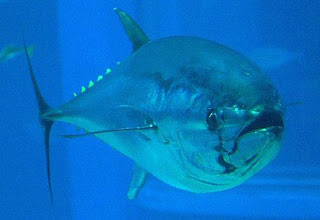
The bluefin tuna is one of the most majestic animals in the ocean. It's size rivals that of swordfish and black marlin with weights of over 900lbs and possibly as much as 2,000lbs. It is one of the fastest fish in the ocean as well, capable of exceeding speeds of 60 miles per hour. It is an endangered species that will soon face extinction unless something is done to save them in the very near future.


Over the past 40 years, bluefin tuna populations worldwide are estimated to have dropped by an alarming 72% in the Eastern Atlantic and 82% in the Western Atlantic. (Source of statistic: www.wildlifeextra.com/go/news/bluefin-tuna938.html#cr) For an animal that has the ability to lay millions of eggs, that is a very concerning statistic. Unlike sharks and rays, bluefin tuna mature rather quickly and can live to be over 50 years old. The problem is even with this high reproductive rate, more tuna are being taken out of the ocean than are surviving to adulthood.

As adults, the greatest threat that bluefin tunas face is man, but when they are younger, there is a vast array of fish and other animals that love to make baby bluefin tuna a meal. Bluefin tuna are known to spawn in very large numbers, which is when they are often captured by commercial fisherman. One of the places in the world where the bluefin tuna is being highly exploited is in the Mediterranean Sea. During spawning season, the tuna are spotted using aircraft. From there boats move in and net entire schools of bluefin tuna. This practice of course not only takes a good sized number of fish out of the sea at once, but it also takes the lives of countless baby bluefin tuna that would have otherwise been able to take the place of the adults if they were allowed to be born. This style of fishing for tuna is by no means sustainable, but it is mostly isolated to the Mediterranean Sea. Closer to home, bluefin tuna face another threat.

Long line fishing is a massive threat to bluefin tuna. Of course long line fishing is an incredibly dangerous style of fishing that claims the lives of countless turtles, sea birds, sharks, seals, small whales, manta rays, and any other animal that bites a hook. For the fisherman though, this style of fishing allows them to potentially catch a large number of tuna and hence, make a large sum. The problem is that they don't only catch tuna. So what is driving these animals towards extinction?

In a word. Humans. In more than one word... Bluefin tuna have long been regarded as one of the best sushi items in Japan. In fact, roughly 80% of the tuna caught in the Atlantic Ocean is shipped to and consumed in Japan. The amount of tuna that people are selling is simply too much. Humans are putting way too much pressure on these animals and leaving them with very little hope for the future. At the heart of the bluefin tuna industry though is the all mighty dollar. Bluefin tuna sells for a pretty high price as it's meat is very valuable. In fact, a tuna sold in Japan for 1.6 million dollars (US). There are bluefin tuna farms, but there is even an issue with this. The tuna do not do all that well in these farms and they are repopulate using fish from the wild.

As you can hopefully see, the pressure these animals are facing is simply overwhelming. For an animal that spawns in just two places in the entire world, there cannot be such a wide unregulated trade. Being a highly migratory species, these animals will enter and leave the waters of many countries. In some they are protected, in others they are exploited. Welcome to the plight of the bluefin tuna. This summer, the hunt for bluefin tuna will once again kickoff in the Mediterranean Sea where tuna populations will once again take a sharp decline. Stay tuned to Operation Forgotten as the summer progresses for more blogs focused on the majestic bluefin tuna.

Tuesday, May 14, 2013

Welcome to Operation: Forgotten

Hello everyone, I hope that you are all doing well. After some time off it is time for my spring/summer campaign to get underway. There was some uncertainty that this campaign would actually happen, but the more I thought about it, the more I've come to realize that this is really something that needs to be done. So without further delay. Welcome to Operation: Forgotten.

At the conclusion of my last campaign, Operation Sadistic Truths, a major milestone was reached in the fight to protect sharks and manta rays. Despite these new protections, there is still much work that needs to be done. Sharks are still being wiped off the face of the Earth as are manta rays. The gill raker trade that has seen manta populations destroyed continues to grow and more and more of these gentle giants are being wiped out. Shark finning has not slowed much as 100,000,000 sharks are being killed for their fins every year. To catch you all up on recent happenings involving sharks in the United States, well lets just say things are looking slightly up. Maryland, New York, and Delaware have recently banned the sale and possession of shark fins. These laws are similar to the laws that Hawaii, Washington, and several other states have already passed. New York passing this law was very significant as New York is the largest shark fin hub on the east coast of the United States. There is also a similar bill in the New Jersey government system right now. With that being said, the primary focus of Operation: Forgotten will be sharks and manta rays. This summer though, these two amazing creatures will be joined by a third animal that is quickly headed for extinction.


Venture into the open Ocean and you will without a doubt find all kinds of fish. Few though are as majestic as the endangered bluefin tuna. Sadly these fish are being fished to extinction. Bluefin tuna are regularly caught and sold at a very high price. They are yet another one of the Ocean's apex predators that are being driven to extinction by man's unwavering desire for money. For an idea as to just how rapidly these fish are being wiped out consider this fact. Female bluefin tunas are capable of carrying 30 million eggs. Of course the vast majority of those baby fish will be eaten by other fish in the Ocean and only few will survive to adulthood where their size makes them safe from most would be predators. Just like many other fish, bluefin tuna are known to spawn at the same time, so large groups of them will gather together. It is at this time that they are very vulnerable to nets as spawning often takes place near the surface. Sometimes entire schools of bluefin tuna are taken out of the sea at one time, which does heavily hurt their fragile populations. This will be the first time that any of my campaigns have had any kind of focus on these animals.


Without any words, here are two quick photos to show why these animals are in so much trouble.


To put it simply, far too many bluefin tuna are being removed from the Oceans and unless something is done about it soon, they will cease to exist.

So ladies and gentlemen. Here we are at the start of yet another campaign. For those of you who have been following along since Operation: Bleeding Seas last year, you know the plight of sharks and manta rays which is why I didn't really go into detail about them. If you are just joining us. Welcome! I strongly encourage you to take a look back at my past blogs from Operation: Sadistic Truths and Operation: Bleeding Seas to get caught up on the plights of sharks and manta rays. All three of these animals are crucially important to our world. Losing any of them would be nothing short of a tragedy that could severely alter the face of the Earth. While you go about your daily business, do not forget what is going on in the world around you. Do not forget that these animals are suffering and rapidly moving towards extinction. Do not forget that we, the people who care about them, are their only voices. We are the voice of the voiceless. Never forget. With that being said Operation: Forgotten is officially underway. Expect to see the first blog of the campaign go into some more detail about the plight of the bluefin tuna so we are all fully aware of what is going on with these majestic fishes. From there, expect a bunch of blogs on all three of these animals complete with pictures (sometimes very graphic), videos (new to this campaign), facts, opinions, news articles, and much, much more!